Monthly Archives: October 2016

Photographing A Black Throated Green Warbler with Flash and Higher ISO

Photographing the Black Throated Green Warbler

As I look back on the Fall Warbler images taken in previous years (2014, 2015), I see a lot of photos full of high ISO pixel noise. Back then, I had convinced myself that despite the poor image quality ( IQ), I didn’t want to use anything but available light.

NOTE: Eugene Smith’s reaction to the philosophy of using only natural light:
 “Available light is any damn light that is available!”
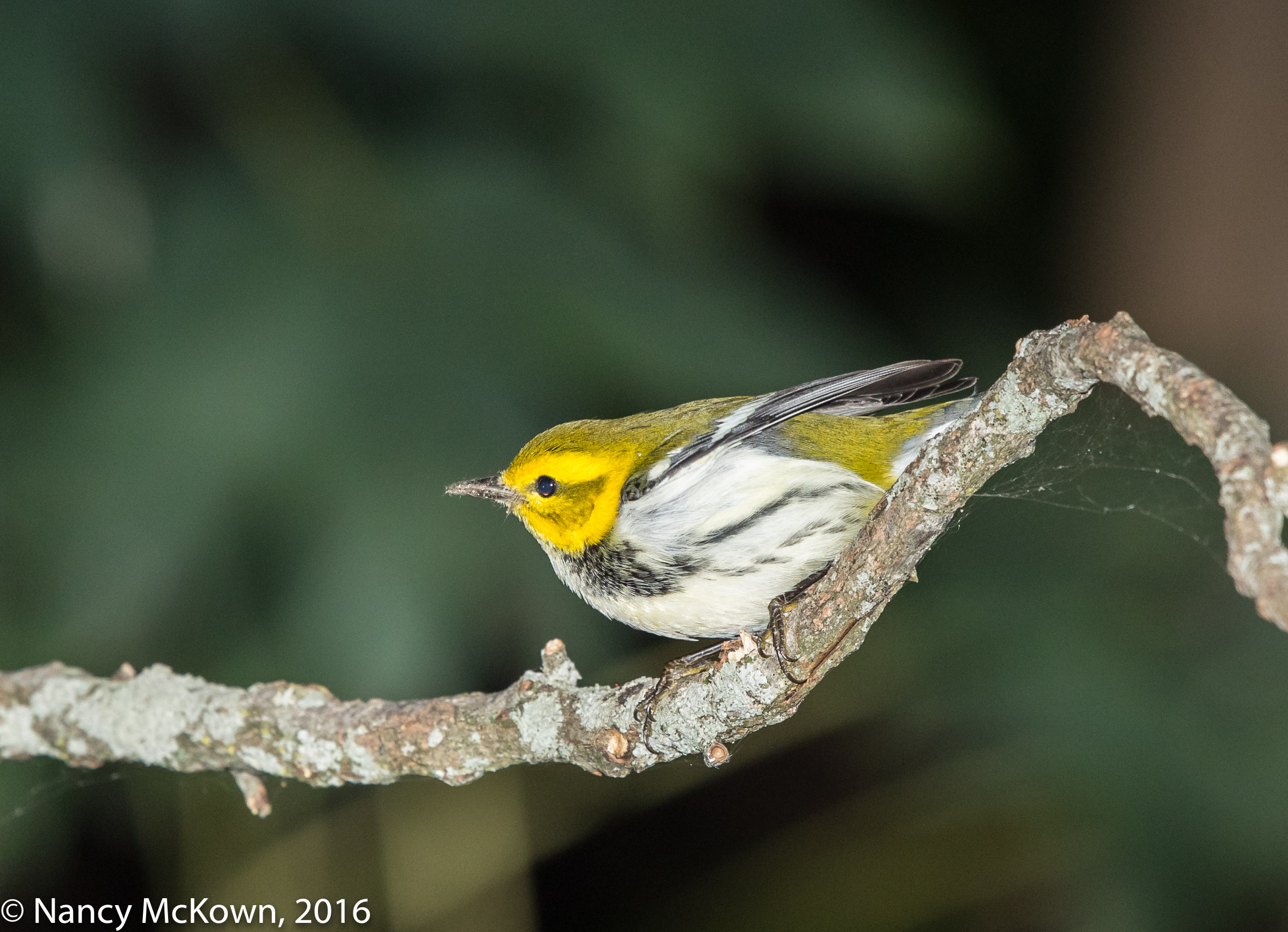
Photo of Black Throated Green Warbler
Black Throated Green Warbler
Too bright uni-directional light.
ISO1000; f/9; 1/250 Second

Balancing the Light

In general, I am pleased with the light provided by the fresnel directed telephoto flash. (NOTE: It is set to automatically manage exposure settings (ETTL) while camera is in manual mode (M). I do fiddle with the FEC to help control the intensity of the light.) The resulting image clarity and color and saturation improvements look much better then the crazy high ISO photos I took in previous years.

At times however, the subject looks too intensely spotlighted and the background is mostly black. This usually happens when the subject is close to the lens, the ambient light is low, and/or the background is just too far away to be affected by the flash.

Ambient and Flash Light Scenarios

Without flash, ambient light is often evenly spread; it may be dim, but the exposure readings for the front and back of your subject should be similar. (NOTE: When your subject is silhouetted because the background is too bright, it’s easy enough to take the exposure readings from the background, lock the exposure settings, recompose on the subject and shoot. The flash should nicely fill in the subject with a more natural looking soft light.)

When you add flash without a fresnel directional enhancement attached, your distant subject will most likely not be sufficiently illuminated. A lot of the light blast will spread wide, bounce and scatter depending on what’s in its path and the proximity of your subject.

When you add uni-directional fresnel telephoto flash lighting intended to spotlight a distant subject, it is more difficult to balance flash and ambient light in the foreground and background. The best you can do is try to control the artificial light’s intensity by modifying the exposure parameters and tweaking the flash exposure compensation (FEC). (NOTE: Other less manageable elements impact exposure parameters; like distance between the lens and your subject and tonality of the subject.)

Exposure Tradeoffs

We all know the low light exposure conundrum. Low ISO settings, tight apertures and fast shutter speeds make the flash work harder to achieve proper exposure and at the same time reduce the impact of ambient light on the scene.

Widening the aperture lets in more light, but sacrifices depth of field (NOTE: On long lenses, depth of field is very tight). As for shutter speed, I am hesitant to try to capture moving birds with anything lower the the flash sync speed  (1/250 second on my DSLR camera).  So that leaves adjusting the ISO.
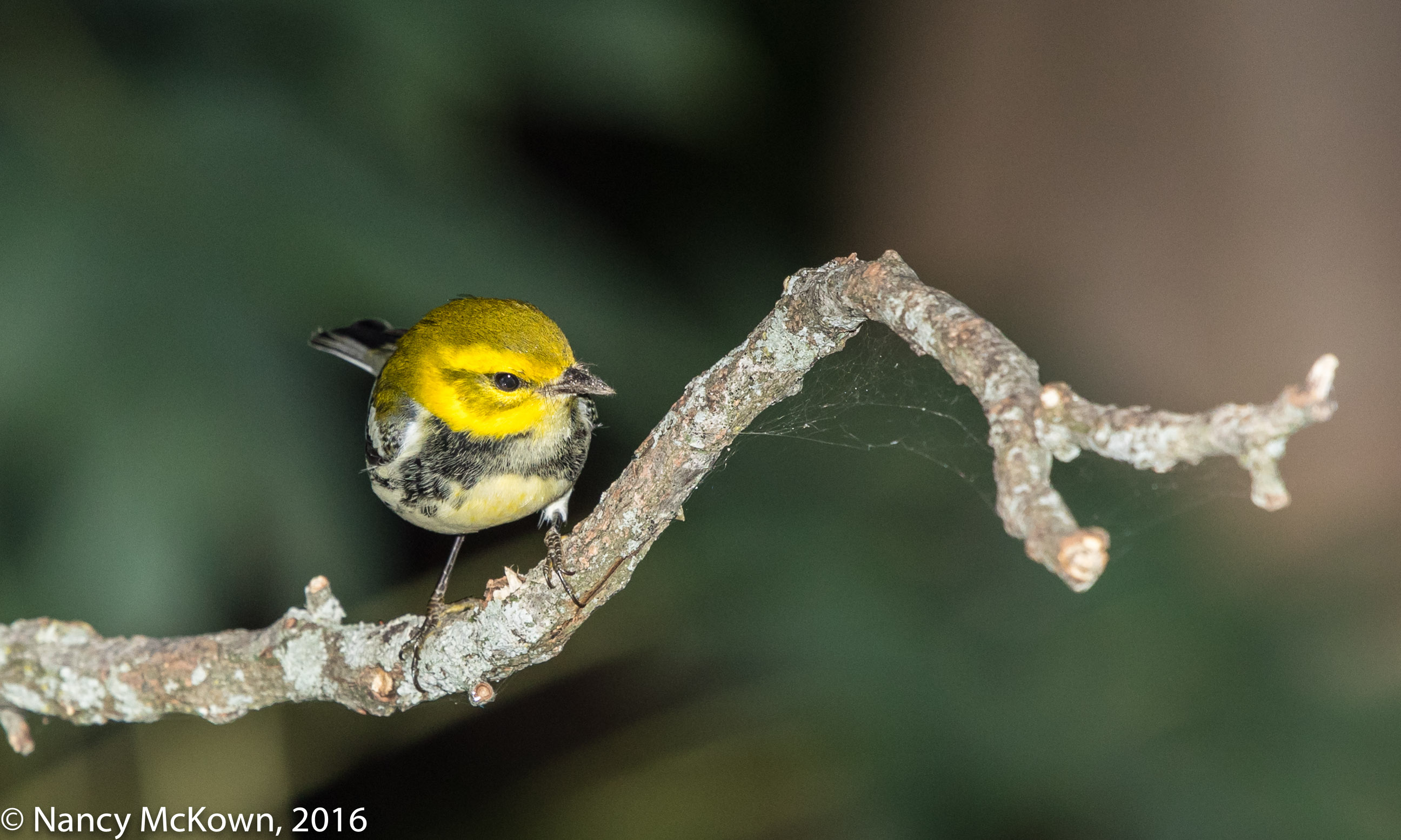
Photo of Black Throated Green Warbler
Black Throated Green Warbler.
ISO 1000 helped… but not enough. 
It is still obvious that this image was taken with
Flash attached.
ISO1000; f/8; 1/250 Second

Raising the ISO to Bring in More Ambient Light

Ultra sharp image quality is directly related to low ISOs, so when I started using the telephoto flash in our heavily shaded yard, I was thrilled to be able to set the ISO at 400 or below.

Lately I’ve been experimenting with raising that ISO when using flash in order to let the ambient light on the scene dominate exposure settings more. This strategy not only helps reduce the impact of the flash blast on the subject, but also creates a better balance of light.

Pushing up the ISO to reduce the intensity of the flash is a very enticing alternative, given the high quality of modern sensors in DSLR cameras. For this photo shoot of the Black Throated Green Warbler,  I experimented with ISO1000, but the flash was still too intense for my liking. The question becomes: How high can I go with the ISO (with fresnel telephoto flash attached) in order to get a more natural looking image and still maintain image quality?

This Black Throated Green Warbler took off before I had a chance to push the ISO above 1000. However, I plan to keep experimenting… raising the ISO up to 5000. We will see what happens.
Photographing the Ruby Throated Hummingbird – Guarding Food Sources

Photographing the Ruby Throated Hummingbird

Ruby Throated Hummingbirds are plentiful in our yard and feed on a wide variety of small insects, spiders, sap and nectar. They linger into early October before commencing on their migration journeys. During Spring and Summer, these tiny birds are commonly seen on and around feeders making them relatively easy to photograph.

Guarding Food Sources

Every time I photograph birds in our yard, I always notice one or two aggressive Ruby Throated Hummingbirds acting like bullies around a hummingbird feeder. This behavior can be described as territorial and takes the form of menacing, purposeful, greedy dive bombing of other hummers who attempt to drink from the same hummingbird feeder.

Photo of Ruby Throated Hummer
Ruby Throated Hummingbird.
An Aggressive Pose.
ISO400; f/9; 1/250 Second

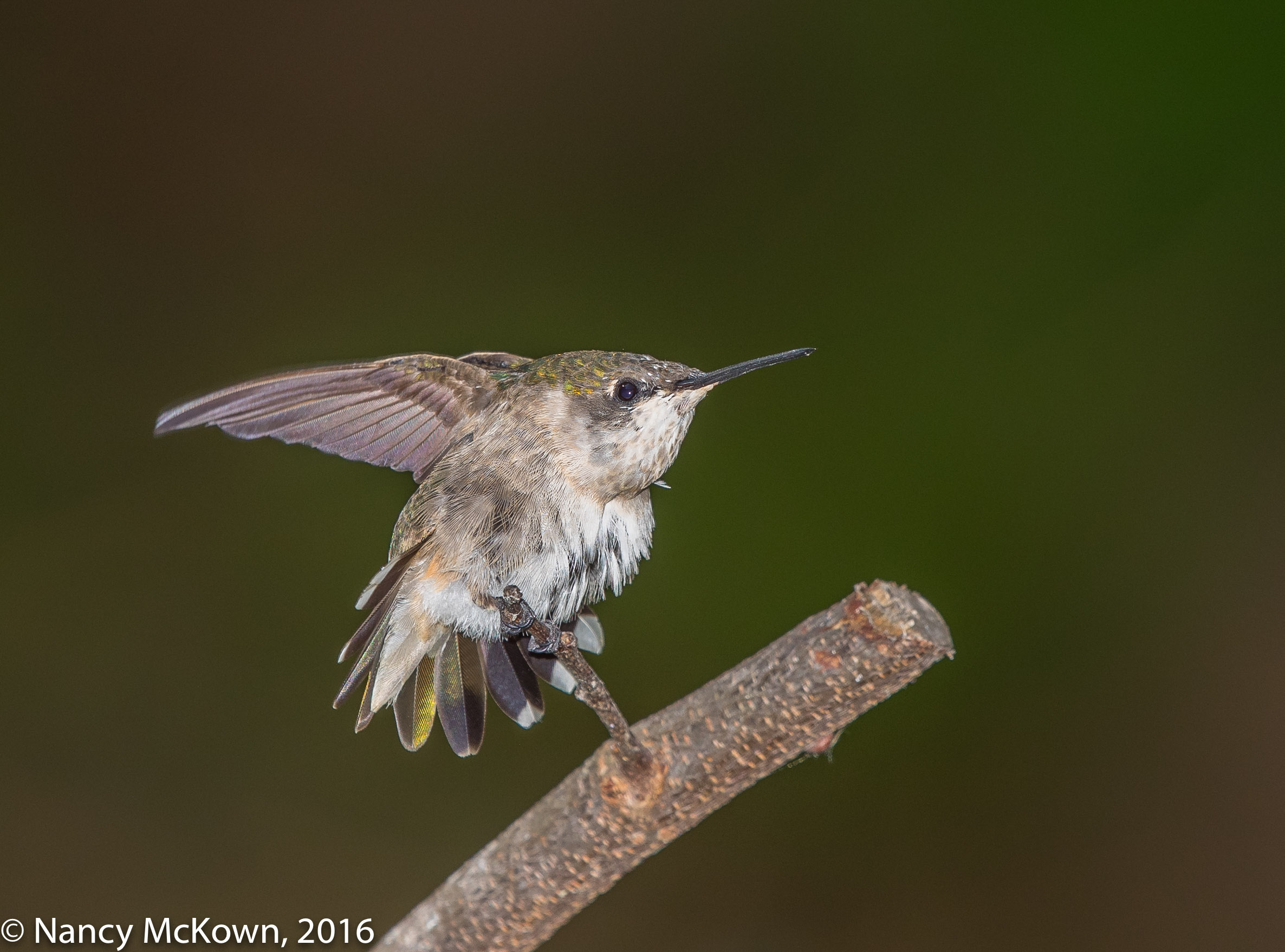
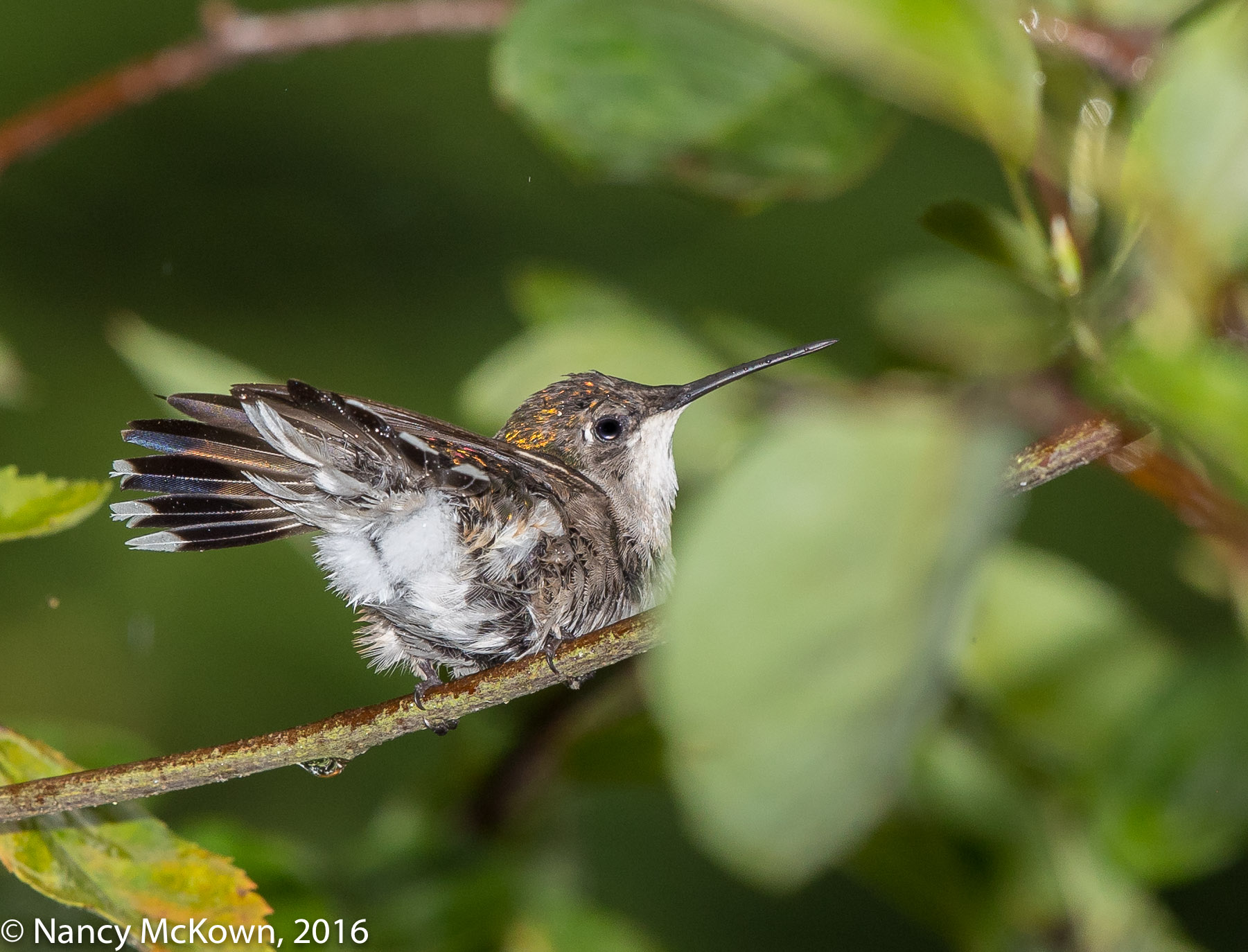
On this particular shoot, an aggressive female unconcerned with me established herself on a camera level perch very close to the feeder. She spent the whole morning standing guard, watching, waiting, only occasionally coming to the feeder for a quick drink. I also managed to photograph another female hummer (see photo below). She crouched down in the wet foliage to hide and watched for an opportunity to sidle past the sentry and sneak in for a drink at the feeder.

Ruby Throated Hummer
Ruby Throated Hummingbird.
This non aggressive Individual
is Watching and Waiting for her
chance at the Feeder.
ISO400; f/9; 1/250 Second

Some (Anthropomorphic) Observations of Aggressive Hummer Behavior

  • The aggressive Hummer (either male or female) will defend food resources relentlessly, so much so that I wonder when they find the time to get enough nourishment for themselves.
  • They are not afraid to insistently confront humans when their feeders run dry.
  • They choose a “watchtower” perch near the feeder that provides the best vantage point from which to watch for trespassers.
  • They create a “no fly zone” into which all other hummers are considered trespassers. If another hummer gets too close, they initiate an attack.
  • This aggressive behavior includes: loud chittering, tail and wing displays, dive bombing, pursuing the interloper until he is out of the designated territory,  aggressive ramming using their chests, sharp beaks, and claws.
  • These individuals guard their food source all summer, right up to the time they leave on migration.
  • Solutions to this behavior include clustering multiple nectar feeders in one area or widely separating them….. making them impossible for one individual to police.
Photo of Ruby Throated Hummer
Ruby Throated Hummingbird
ISO400; f/9; 1/250 Second

There were plenty of opportunities to photograph the hummers on the feeder, but where’s the challenge in that?  I wanted to capture some hummer flight action– but for the most part, the dizzying speed and agility of these little birds left my tracking abilities in the dust. I did manage to capture the aggressor hovering over the feeder in between dashes to and from her watchtower perch.

Hoping for a Vagrant Hummer to Visit

As I sit and watch the birds, I keep hoping I will see and photograph an uncommonly seen species of hummer as she passes through our yard in the Fall or Spring. The most likely species for Southwest Michigan would probably be the Rufous Hummer. More rare and accidental spottings have been documented in Michigan of the more elusive Broad-billed Hummingbirds, the Green Violet-ear Hummingbirds, and the White-Eared hummingbirds.

It could happen.

Photographing a Perky Wilson’s Warbler – Dealing with Inadequate Flash Power

Photographing A Wilson Warbler

A soothing fall day. Just a few bright withered leaves drift down. Soon there will be plenty of light.

It’s early October and the number of migrating birds who have interrupted their journeys to take refuge in my yard has dwindled. A few jewels may still appear. The camera and long lens are set up in the house pointing toward the dense foliage near the fountain. The scene is not reflecting much light on this breezy morning. The background is thick and indistinct.

The camera is set on low speed continuous shooting and al servo focusing mode – perfect for fast moving birds. But in low light, it doesn’t matter how fast the camera can burst if the flash is weary after the first one or two shots.

Photo of Wilson's Warbler
Wet Wilson’s Warbler
Bathing at Fountain
Flash Engaged
ISO 400; f/9; 1/250 Second

Slow to Recycle

The more I use my flash, the more evident it becomes that AA batteries recharge it too slowly for bird photography. One shot – wait.  One shot – wait. This seems true even if I need only a touch of fill light and use a fraction of what the flash can deliver. I have to pause… hold myself back –slow down my shutter action to give the flash gun time to recover.

Photo of Wilson's Warbler
Wilson’s Warbler
Taken with Flash extender
ISO400; f/9; 1/250 Second

Wait Time Analysis

Here’s a quick analysis of the situation:

  • Recycle Rate on Canon 580 EX II Flash is 6 seconds (with fresh AA batteries).
  • With 8 additional batteries attached, (Canon CP-E4 Compact AA alkalide battery pack) recycle rate time decreases to 2 seconds (with fresh batteries).
  • The speed of low speed continuous shooting mode can be as high as 13 frames per second on modern Canon DSLR cameras. (Note: Lots of issues can impact the speed of continuous shooting– most especially if you set your camera to shoot RAW rather than JPG).
  • In ETTL mode, longer distances between flash and subject as well as tight apertures, low ISOs and higher shutter speed settings (Max 1/250 per second in flash mode on my camera) will cause the flash gun to work harder.
  • Fast draining batteries impact speed and responsiveness of flash unit. In addition, going off task to swap out dying batteries takes time.
  • No wall power adapter is available for the Canon 580EX II flash gun.
  • The tube on the Canon 580 EX II flash gun will start to overheat after 15-20 flash bursts paced at 2-5 seconds apart. This bumps up flash recycling time to 8 to 20 seconds. Soon after, the over burdened flash will require a “rest time” of 10-15 minutes. (NOTE: An overly heated Canon flash gun will give thermal warning and shut down flash operation to avoid permanent damage to the flash. There is no override switch to cancel shutdown on the 580 EX II.)

NOTE:  The flash may shut down, but not the camera. If I continue fast shutter action without a flash, I will end up with a lot of very noisy (5000+) ISO images – assuming the ISO on the camera is set to AUTO.

Prodigious Power Users

Modern flash guns are prodigious power users. Lots of photographers choose to replace the AA batteries with powerful, light, versatile and portable lithium ion power packs and chargers designed to recharge faster and last longer.

More Power, Faster Recycle

On a friend’s recommendation, I researched Flashpoint‘s Blast Power Pack PB-960. It was the least expensive lithium ion power pack I could find. The customer reviews were very good.

  • You can regenerate your flash unit to full power in less than 1 second. When the power pack runs dry, it’s a simple matter to swap it out for a fresh unit. A $20.00 cable to join two batteries to one power pack will cut the recycling time in half.
  • Power pack battery life is rated to deliver 1800 full power shots.
  • A bright LED power level indicator on the unit keeps the photographer aware of power drainage.
  • With very little fuss, heavy duty locking cables securely attach to the flash unit.
  • Lithium Ion battery recharge time takes approximately 3 hours…which is why you need an extra battery to swap out with the drained one.

NOTE:  Wedding photographers must love carrying the Flashpoint PB-960 on their gear belts. It is engineered to power two different flashes simultaneously off the same power pack.

A Better Option than AA

The Flashpoint lithium ion power pack definitely performs faster than AA batteries, providing more consistently reliable, portable power. It’s not a cheap date. I bought the power pack, 2 batteries, recharger, and carrying strap for $350.00.

Controlling My Trigger Finger

What seems like an interminable wait for my flash to respond is really not. I was able to get 3 or 4 different, well lit shots of the Wilson’s Warbler when he came to refresh himself at the fountain. If I feel the need to hold down the shutter in order to get the perfect shot, more of the images will be adequately illuminated with the Flashpoint attached.

However, no lithium ion power pack will be able to keep up with camera bursts, nor for that matter, will the flash gun. I’ll just have to learn to control my trigger finger when using flash.

Photographing Female Cardinals– Birds and Disease Transmission

Birds and Disease Transmission

When I’m out photographing birds, I have plenty of down time to watch and think about the complex relationships and interactions between birds and other species. Recently, I was very interested to read about how Northern Cardinals indirectly help reduce the spread of West Nile disease.

Northern Cardinals (along with most other birds) play an essential role in the transmission of disease to humans. When a female mosquito successfully pierces a bird’s skin to probe for blood vessels, suck blood and then leave behind saliva, that bird will become a host to any viral infections carried by the biting mosquito. The infected bird will then spread the infections to the next mosquito who pierces her. Eventually down the line, an infection carrying mosquito will transfer the virus to a human.

How Northern Cardinals Fit In

Some species of birds don’t offer the same quality disease spreading services for blood sucking insects.

Epidemiologists at the CDC claim that when virus carrying mosquitos feast on the blood of Northern Cardinals and infect them with West Nile Virus, the virus does not circulate in that species bloodstream at the level required to transmit the disease to the next mosquito host. Scientists surmise that this disease can be slowed or even halted by an unaccommodating bird host like the Northern Cardinal. Fewer infected mosquitoes means fewer transmissions to humans. (NOTE: Other species of birds that may also suppress this disease are Northern Mockingbirds, Gray Catbirds, and Brown Thrashers.)

So the proliferation of West Nile disease (in the U.S. since 1999) depends on which birds are infected. To make this phenomenon even more fascinating, epidemiologists are finding that the appetites of mosquitoes change mid summer so they are more likely to choose to take their blood meals from poor hosting species like Cardinals, thereby slowing down exposure to humans.

Female Northern Cardinal
Crest held high.
ISO640; f/8; 1/800 Second

Photographing Northern Cardinals

Northern Cardinals are one of the most common year-round residents in our yard. They are cautiously bold and curious, perching on or around the bird feeders near the windows to forage. No other bird in our yard is as easy to approach with a camera. When I make plans to photograph Cardinals, there is little need for me to venture outside with my camera and become a blood meal for mosquitos and ticks.

It’s the coloration of the female cardinal that I find most eloquent. Subtle olive brown feathers are tinged with red on the crest, eyebrows, wings and tail. Her bold red/orange cone shaped beak matches the male cardinal’s beak, but appears less protuberent against the more understated colors of her face.

When I took the photo above, the sky was almost completely covered with sun obscuring clouds, making for a bright but diffused light. Diffused light softens the contrasts across the whole image, making for a more even and balanced look. This type of light creates less of a distinction between the shadows, highlights and mid-tones.

Showy Bird Crests

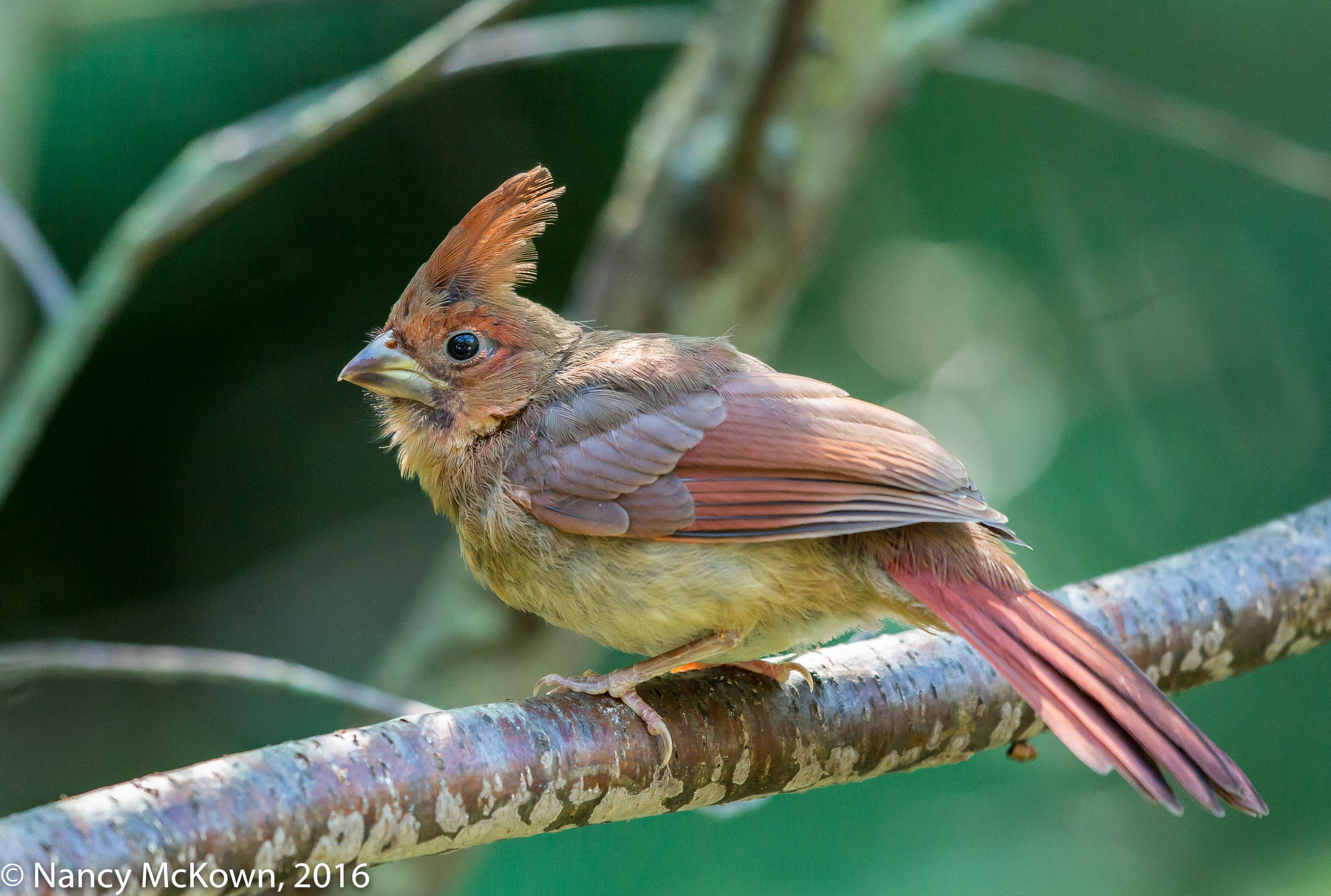
When focusing in on a female Northern Cardinal, I normally try to include a capture with her crest held high. If she notices the camera, her crest generally goes down, perhaps an effort not to be detected. When a bird sports a crest, she can raise and lower it to indicate mating readiness, nervousness, excitement, caution, and fear. These upright barbs high on the bird’s crown are made of soft, bendable fluffy feathers which can be raised high in a perky salute or tucked back smoothly on the head. Nestlings and newly fledged Cardinals often display still growing crests that look more threadbare.

Female Cardinal
Fledgling Female Cardinal.
No Red Beak Yet.
The light was less even, consequently,
More shadows and highlights are
visible in this image.
ISO2000; f/4; 1/400 Second.

To view photographs of Northern Cardinals engaged in courtship feeding, press this link.