Often when I’m out in the field with my camera, I see the perfect shot…..a scene with shimmering light, balanced and beautiful. The only thing missing is the bird.
My imagination starts rolling over a wide variety of picture perfect scenarios, I swap out different ideas. Creativity is sparked. Time flies. Visions are embossed in the back of my mind, and I move on, always hoping, always measuring those visions against the images I actually shoot.
Am I day dreaming, or is this a mental exercise heavily mixed with hope and inspiration? (No doubt some of these visions are just improbable scenarios.)
And Then It Happens
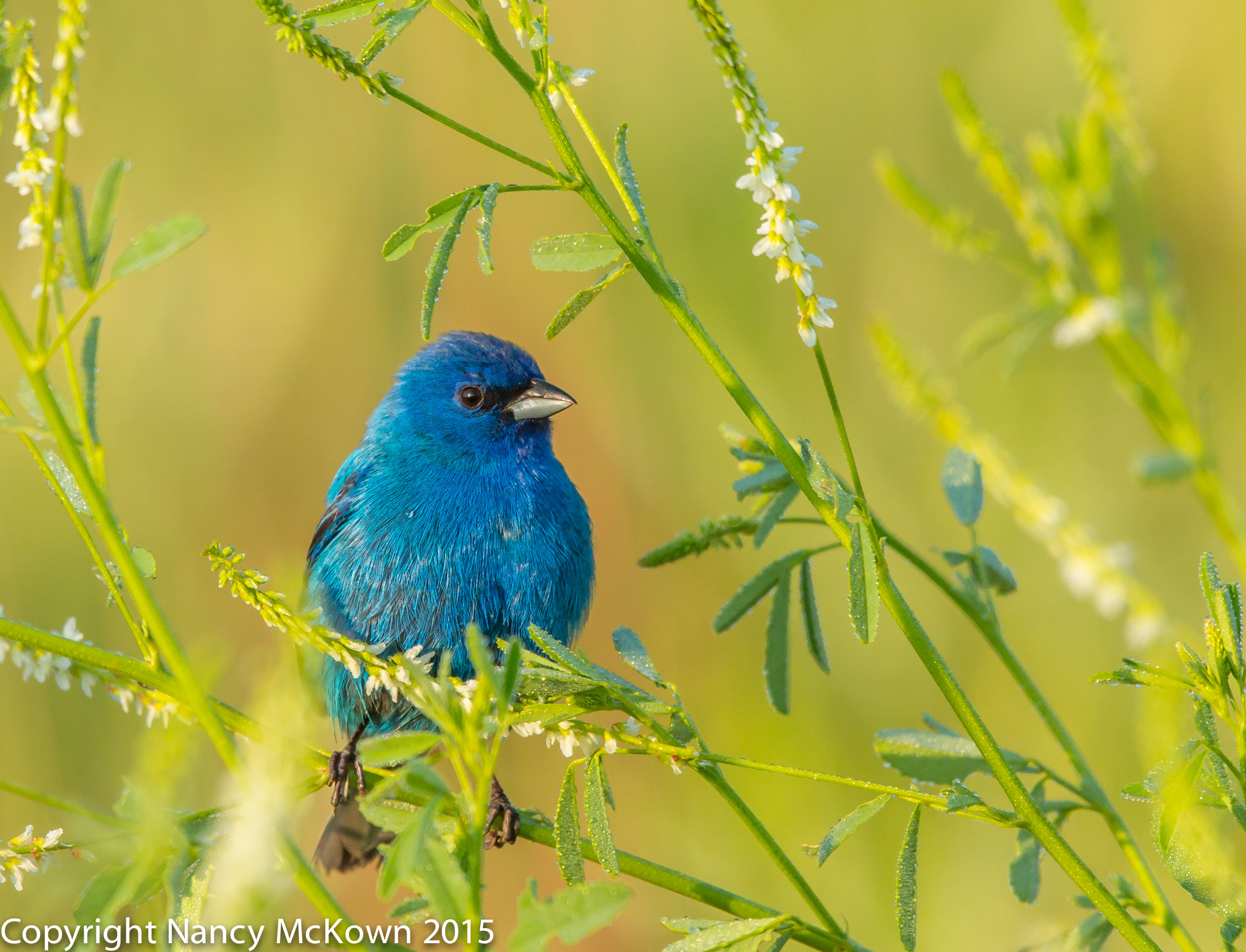
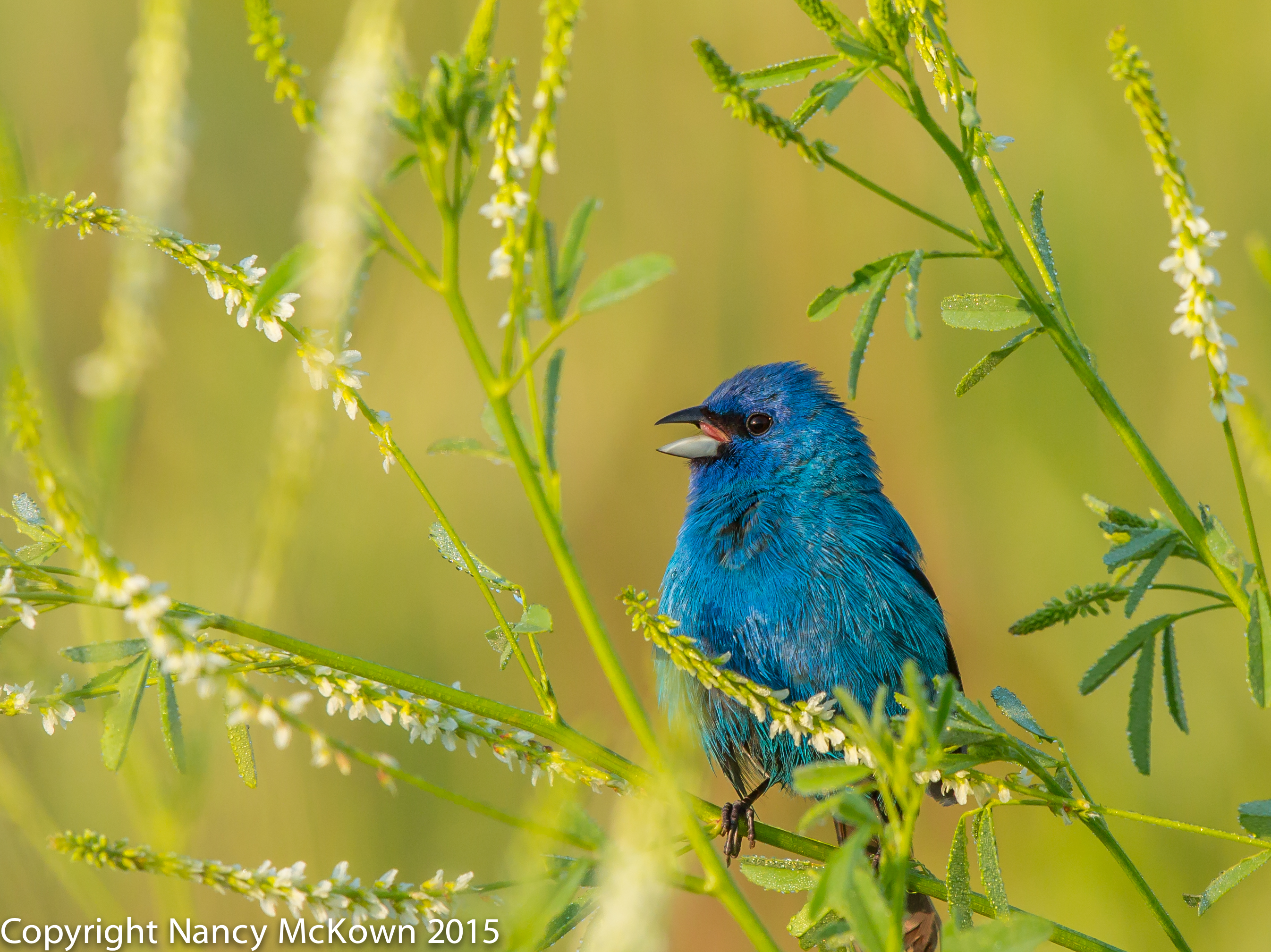
I pass by a graceful field of flowers, a golden sunrise low in the sky, mist droplets shimmering on the leaves. A male Indigo Bunting in glorious plumage swoops in, perches low within the flowers, but still in full view. I fire off a burst, and then he’s gone.
One of those shots was perfectly lovely. For once I had an image that matched my vision.
A Peaceful Setting for this Singing Indigo Bunting. ISO800; f/8; 1/1000 Second
Acting Out Your Dream
Start pre-visualizing your ideal photo. (NOTE: This is not the same as arriving on site with an open mind.) When your dream bird suddenly arrives in the perfect place at the perfect time to act out your vision, be ready with all your best equipment and a steady hand.
You will know when you’ve got it. Doesn’t matter if anyone else likes it or even knows. In the meantime, stay open to all the dreamy possibilities your mind may have to offer.
To read more about Indigo Buntings, visit this post.
Photographing the Subtle Beauty of the Gray Catbird
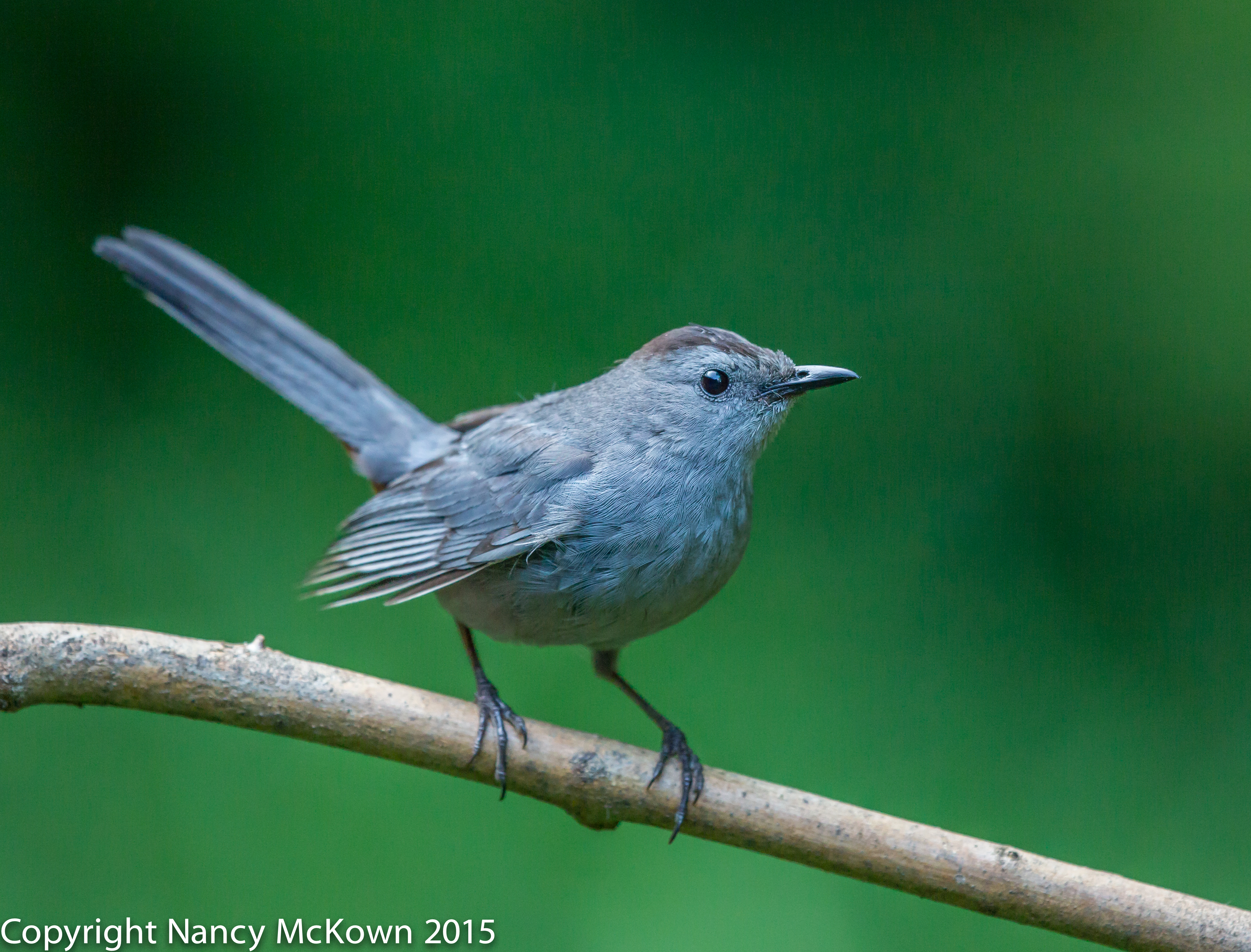
Catbirds are unknown to most of my non-birding friends. I think these birds are often overlooked because they resemble the more common and conspicuous blackbirds. The Gray Catbirds’ beauty is quite subtle. Both male and female are overall gray, with dark eyes, and black on its cap, tail, bill, legs and feet. Rich rusty feathers peek out from under its wings and tail. Not shy, Gray Catbirds are commonly found at feeders, snacking on everything we have to offer. Once in a while, I’ll see them eat the oranges we put out for the Woodpeckers and Orioles.
Gray Catbird The Morning Light and the Creamy Background Bring Out more Rusty Brown in the Wings. ISO 1000; f/4.5; 1/800 second
Playing with Natural Light
The Catbirds in our yard are numerous and stay around all summer. I photographed these Catbirds before the heavy leaf cover from our tall trees grew to block much of the good light in our yard. I set up the tripod, camera and 500 mm lens on the porch and got a cup of coffee. No need to hide behind a blind for these curious birds. As long as I didn’t make any sudden movements, they flew in close to the house and went about their business with hardly a look in my direction.
I had the time and opportunity to just play -photographing the Catbirds at different times against diverse backgrounds. I got off the porch and experimented with the directionality of light.
Compare the shadows, textures, and the colors in the two photos (above and below) to see what a difference changing out the natural light can make.
If you want to explore how to manipulate light in your images, don’t get into the rut of going to the same place at the same time. Move the camera and tripod around. Observe and learn how your lens sees light.
Gray Catbird, Tail held High Perching Against a Lush Green Background in Late Afternoon.. More Gray and Less Brown on the Feathers. ISO 2000; f/4; 1/500 Second
Listening for the Gray Catbird
For the longest time, I heard but did not see what I thought was a Brown Thrasher singing in our yard. There may have been a Brown Thrasher or two around, but the songs I heard most likely emanated from the much more numerous Gray Catbirds–another mimic thrush.
The Gray Catbird is a member of the mockingbird and thrasher family and known to imitate other birds, mammals and electronic devices. Catbirds are best known for their scolding, screeching, nasally, cat sounding song. Besides his cat calls, the Catbird repertoire includes stringing together many, many lesser known songs, some joyful, but most just odd twitters and tweets. When they are not singing or eating, they like to roll around and splash in the fountain.
The Catbird Seat
According to Wikipedia, “The catbird seat is an idiomatic phrase used to describe an enviable position, often in terms of having the upper hand or greater advantage”. Easy to speculate as to why the catbird is associated with this folksy phrase. It’s most likely because the males stake their territorial claim by singing a wide variety of birdsong (loudly and early in the morning) from the highest and most advantageous point around.
(Please click on this link to learn more about another mimicking thrush, the Brown Thrasher)
It’s summer time, and the Baltimore Orioles abound in their splendor.
Summer is also the time when we are invited to a lot of outdoor weddings. Lots of splendor to ponder there as well… the couple, the gowns, the flowers, the guests. My mind drifts to making observations about the wedding photographers who are engaged in a very different sort of photography than the craft I practice.
Male Baltimore Oriole Singing His Heart Out. ISO 500; f/4.5; 1/640 Second
Basics for All Photographers
But is wedding photography so very different than bird photography? I look over the photographer’s camera and her moves, looking for evidence of skill, efficiency, art, and respect. I can’t help but conclude that all photographers must share the same basic principles to be effective and productive.
At the Low End
On the wide spectrum that includes the best and worst of photographers, it’s easy to spot the rookies…or the ones who just don’t care. These are the people who rank on the low end of the effectiveness meter. Somehow, whether due to ignorance or arrogance, they do not understand what it takes to be successful and are often delusional about what is expected in a situation fraught with uncertainties and uncontrollable events.
Some specific observations:
They think showing up accomplishes 95% of what they are there to do.
They plan to get in and get out as they are squeezing this shoot in on their way to somewhere else.
No time is set aside to check the weather, understand the layout of the location, study the lighting challenges and opportunities, evaluate the backgrounds, and mentally setup the shots for optimal results.
Respect for their subjects is seriously lacking as is an understanding of group dynamics.
They do not know how best to get their subjects posed attractively.
They are not in the right place at the right time to capture those special moments.
They arrive unprepared. Worse, they do not anticipate complications nor do they know how to troubleshoot.
They bring only themselves, one all purpose camera and lens, one compact disk, and one blinding flash affixed to the top of the camera and aimed directly at their subjects.
They do not dress appropriately nor do they try to be unobtrusive to the events around them.
They do not search out opportunities that have the potential for candid and stunning photographs.
They put no effort into post processing, nor do they screen the photos to eliminate those that are out of focus, poorly framed, uninteresting, and/or redundant.
Baltimore Oriole ISO 800; f/4.5/ 1/800 Second
Photographers’ Skill Set
The skill set of a good photographer consists of a hard earned complement of components – all working together with the best equipment that the photographer can afford. Photographers at the top of their game are diligent in observing and respecting their subjects as they struggle to achieve the milestones of their lives. They understand that things do not automatically fall into place and when something unexpected and wonderful happens, they react quickly and professionally.
Beautiful photos are the result.
Press this link to read about Control as an Illusion.
Press this link to read more about photographing Baltimore Orioles.
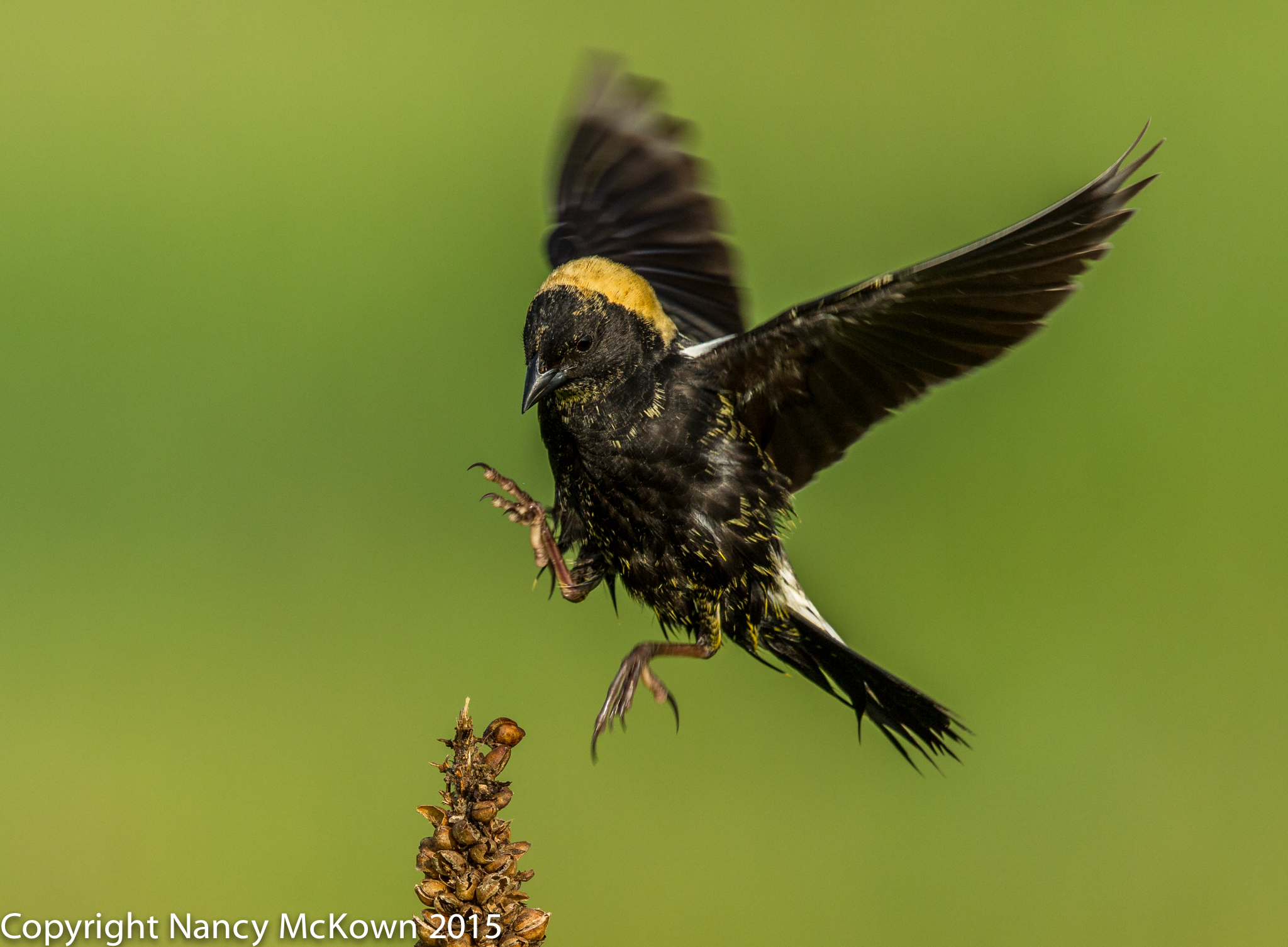
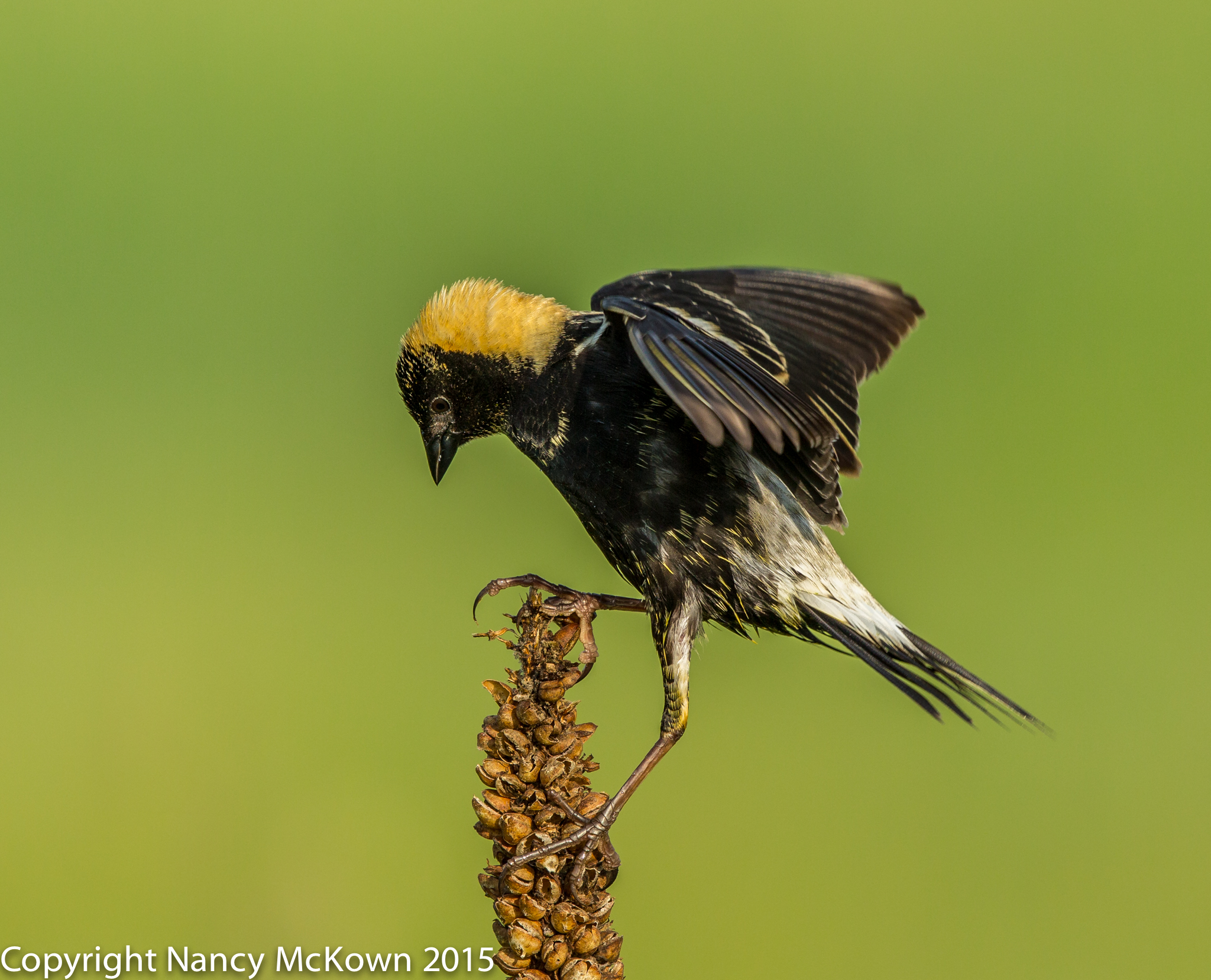
A friend and I were having a marvelous time photographing, from the side of the road, two (or possibly three) male Bobolinks.The birds were taking turns scaring each other off. They would circle multiple landing sites and then light on an isolated mullein flower, close to the cameras, that offered a lush green background. The Bobolinks were definitely competitive, carving out territories and vying for ownership of this one little mullein stalk. It gave us ample opportunities to practice landing shots.
Bobolink Coming in for a Landing. I like the Motion Blur and His Right Wing Although, I Just Barely Got that Wing in the Frame. ISO640; f/9; 1/1250 Second
Photographing Landings and Takeoffs
The morning was sunny and windless. Over and over, a Bobolink would gracefully touch down and try to stabilize himself. My lens was resting firmly on the car door and focused on the top of the closest mullein flower. Trying to anticipate the perfect moment to press that shutter button, my eyes intensely tracked the flight of each bird as he circled and then came in for his landing.
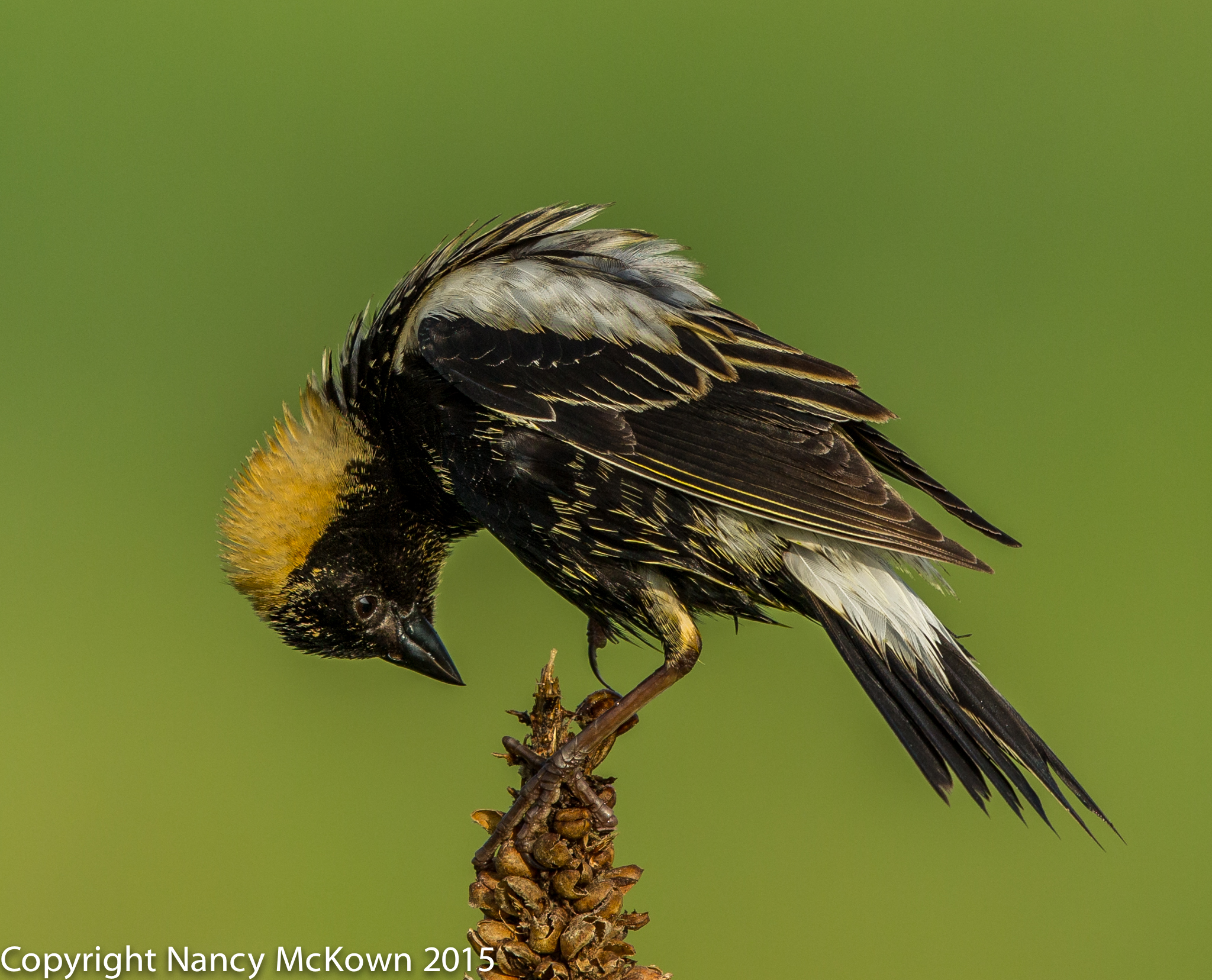
This task definitely requires some precision, and lots of practice. I was successful only a couple times with the landing and take-off shots, but was able to capture the complex efforts the birds made to brace themselves on the mullein stalk. The legs and feet on Bobolinks are large, long and prominent, perfect for grasping and clamping on all sorts of perches. The toes are independent and flexible, three toes in front and one stabilizer in the rear. You can see in the photo below how this Bobolink works his feet and his wings to balance himself.
Male Bobolink, Using Both Legs and His Wings to Try to Steady Himself on the Mullein Flower. ISO400; f/8; 1/800 Second.
Noticing Deformities While Photographing Birds
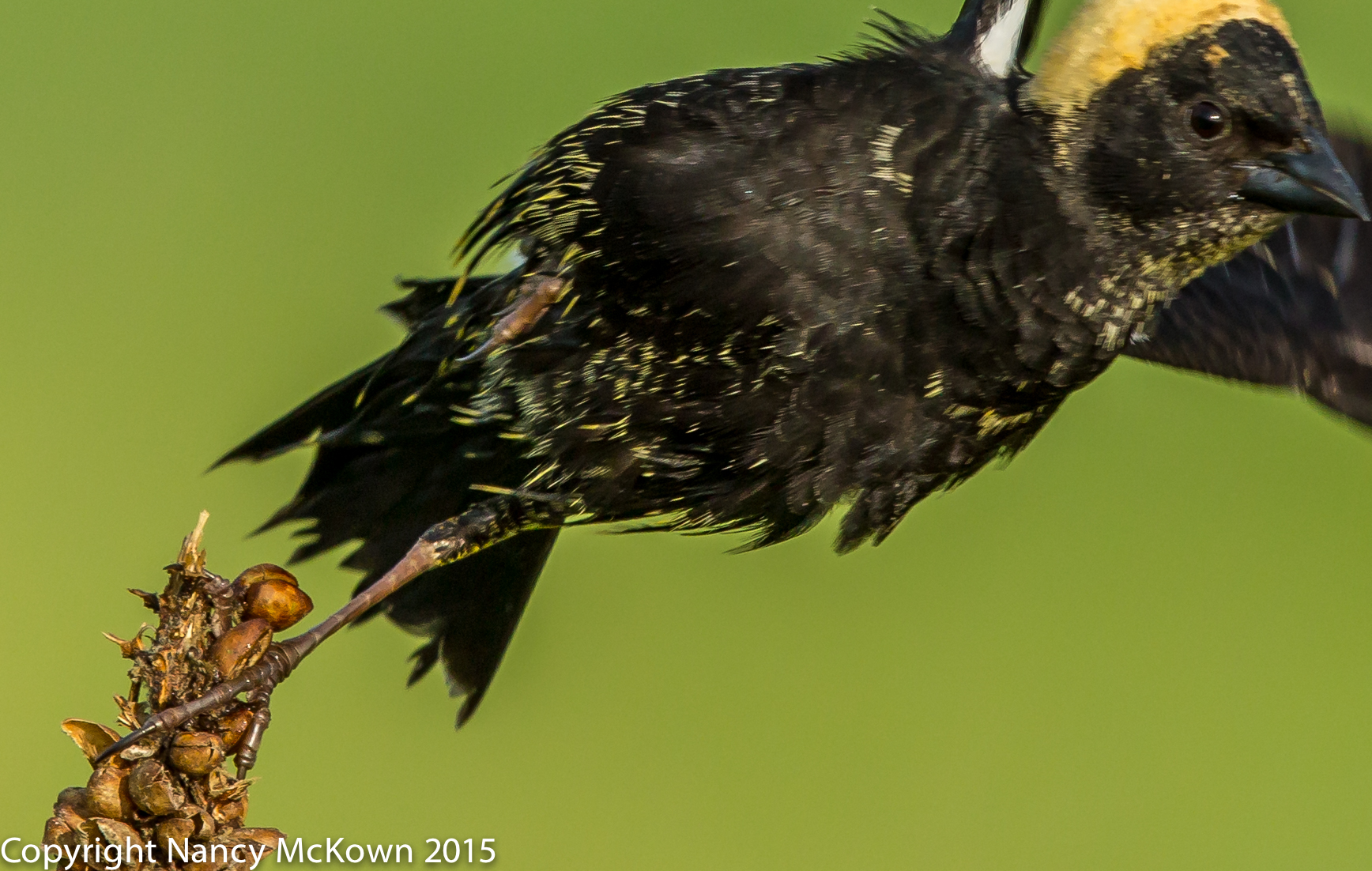
My 500mm lens allows me to get close to the action and see many details. It was not until after I downloaded the photos onto my computer that I noticed that the right leg on one of these male Bobolinks has only a partial foot and one claw. Sadly, I was not able to get a landing shot of this handicapped bird, but the three photos below reveal that even with one deformed leg, he accomplishes his takeoffs and landings quite well.
Male Bobolink Using His One Good Leg to Try to Steady Himself on the Mullein Flower. ISO320; f/8; 1/800 SecondFrontal View of Male Bobolink- Balancing on the Mullein Flower with one leg. ISO640; f/9; 1/1250 SecondClose up of Deformed Leg of Male Bobolink, as he Leaps of the Mullein Stalk. ISO800; f/9; 1/1250 Second.
Photographing Birds in Restricted Areas
Not all birders and/or photographers respect the birds’ habitats. They trespass into restricted areas and cause serious disruptions as the birds go about their mating and nesting rituals. The DNR officers are charged with protecting the wildlife and enforcing the rules on all birders and photographers, respectful or not.
I was born well into the last century and I have always been a member of the teacher pleaser class known for respecting and following the rules. So why did I feel offended when the DNR officers told me recently that while photographing birds at the Todd Farm Bird Refuge (in the Allegan County Game Area), I could not stop the car in the road, prop the camera on the door window and photograph birds from the car. The officers said that I must first park the car in one of the designated parking areas and walk (hauling all the equipment) to an approved location (mainly on the road) from which I could set up and shoot.
Of course, I’ve parked, hauled and set up equipment in the past when I found a location that, given time and favorable conditions, would be productive to photograph birds. Being the rule follower that I am, I have always set up on the roads and pathways, staying well clear of the prairie and wooded nesting areas.
A Little Mutiny
I’m feeling offended because bird photography is so much more than walking to a location with all the photo gear, then waiting and hoping for the best. More important and exciting is the opportunity to explore beautiful back country roads in a vehicle, camera at the ready on my lap. There is always the hope that on these exploits, a fabulous and serendipitous encounter will occur, unknown, exciting and captivating. Seconds later, if I’m on my game, I will have a wildly pounding heart and wonderful photos.
Well…Just saying…. that driving around on public roads with my camera in my car, looking for an occasional and unanticipated thrill is too much to give up, teacher pleaser or not. Nope. They can’t take that away from me.
To read more about photographing Bobolinks, press this link.
Post Processing is a necessity for today’s digital photographer. I use Lightroom by Adobe. The fun part of bird photography is watching the birds in their natural environment and then sizing up the light, equipment and scenery to most effectively capture what I hope will be beautiful images. I don’t spend a lot of time with post processing chores. Usually, I just apply one or two global adjustments.
More Precise Post Processing Tools
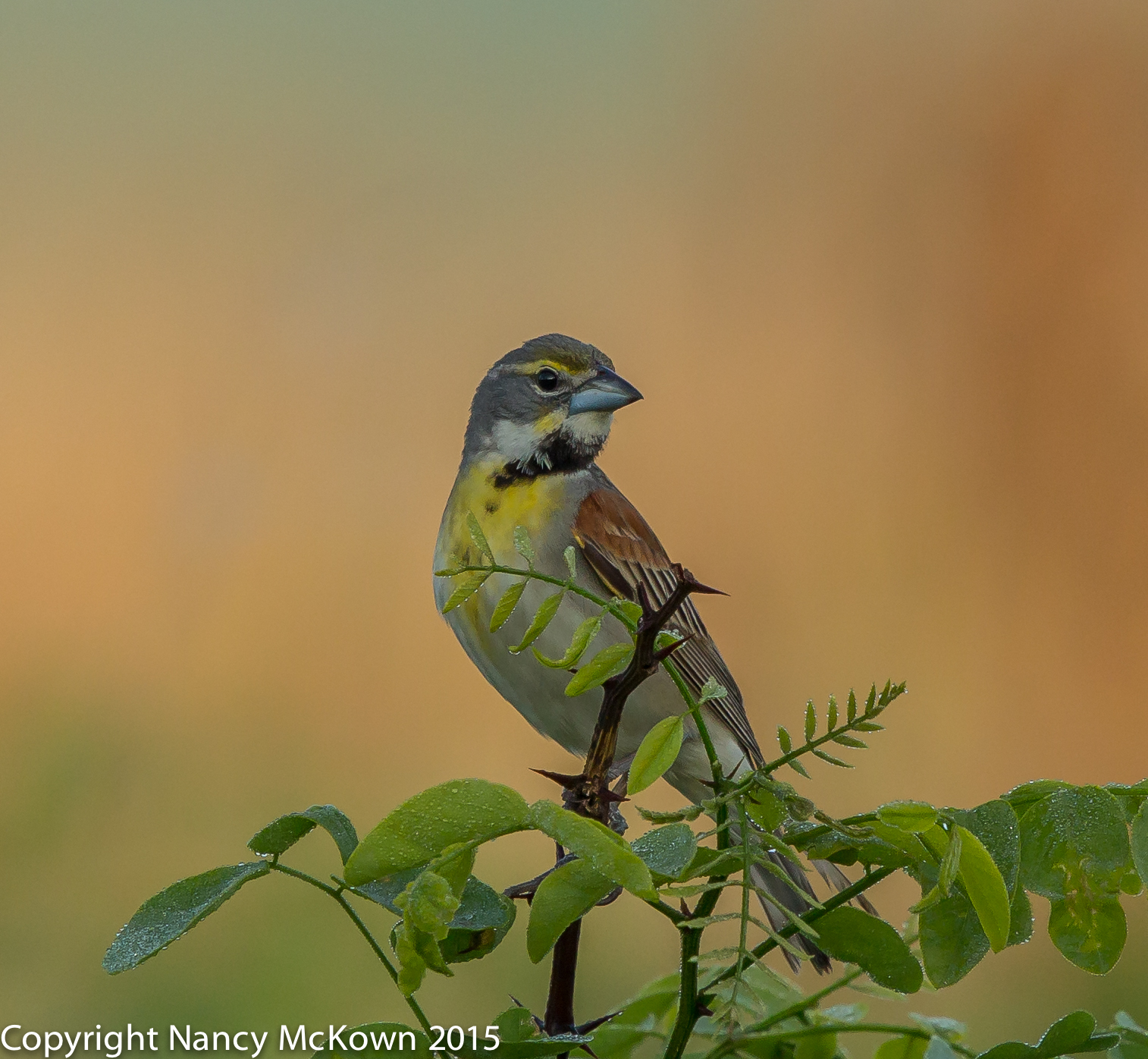
At times, however, I recognize that more precise adjustments are needed to portions of my photos. For instance, some images just need a little light on one side of a bird’s face and breast, or just a tweak of sharpening around the outline of the bird’s head, while leaving the background blur alone. I was pleasantly surprised to learn how easy and effective it is to apply partial and subtle improvements to my images with specialized post processing tools.
Male Dickcissel Blurred Golden Grasses in the background gave me the perfect opportunity to use Nik to fiddle with the background color. ISO800; f/8; 1/1000 Second
For the Artistically Inclined Photographer
A quick search on the web brings up several post processing toolchests that work with Lightroom and Photoshop. According to the reviews, these work well if you wish to selectively add a little drama through intensifying certain colors, or if you wish to fix one little thing so it draws the eye more (or less), or you want to massively change all aspects of an image to your liking.
I downloaded the 15 day free trial (no credit card required) of Nik Software, mainly because it came highly recommended by a friend. My favorite tool was Vivenza 2. You can purchase the package from Google for $150. It’s a good deal.
Warning: Artistic inclination is a must.
Nik Software, by Google
It was fun to play and it didn’t take long to figure out the functionality of the seven plug-ins included with NIK software. These include:
Simulate the retro film emulsion look with Analog Effects Pro 2,
Selectively sharpen portions of the image with Sharpener Pro 3;
Selectively reduce noise to portions of the image with Define 2;
Selectively adjust color (and add borders) with Color Efex,
Selectively adjust brightness, contrast and white balance with Viveza 2
Be creative with black and white with Silver Efex Pro.
Process HDR images with HDR Efex Pro.
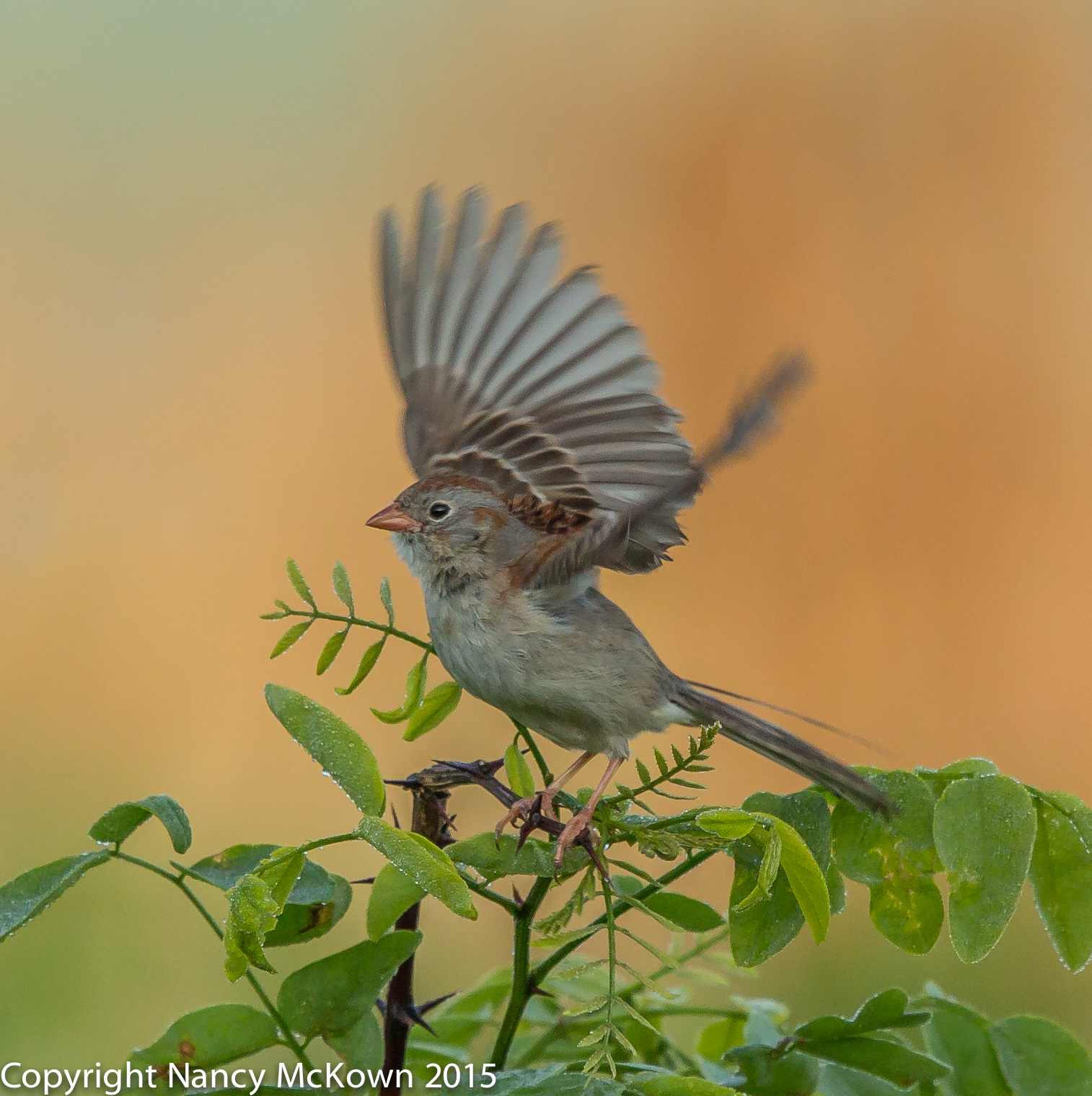
Field Sparrow Coming in for a Landing I sharpened the sparrows head and beak. ISO800; f/8; 1/1000 Second
Shine Light into Dark Corners
Certainly it’s easier and more gratifying to get everything in the image perfect right when you snap the shutter. That doesn’t happen very often in bird photography. Lightroom does have the functionality to allow the user to tweak portions of an image by setting up “masks”, but I find that to be a tedious process resulting in unimpressive results. It’s so much easier to download a set of plugins that offers user-friendly options and good results. You can remove all or part of the adjustments if you don’t like them.
An excellent description and review of the Nik Software package by William Beem, is available at this link.
NOTE:
NOTE: As of May, 2017, Google will not update the Nik software suite. Specifically, “We have no plans to update the Collection or add new features over time.”
To read another blog posting on Dickcissels, press this link.
To read another blog posting on Field Sparrows, press this link