Monthly Archives: May 2015

Photo of Female American Redstart Warbler

Photographing A Curious American Redstart Warbler

A Curious Female American Redstart

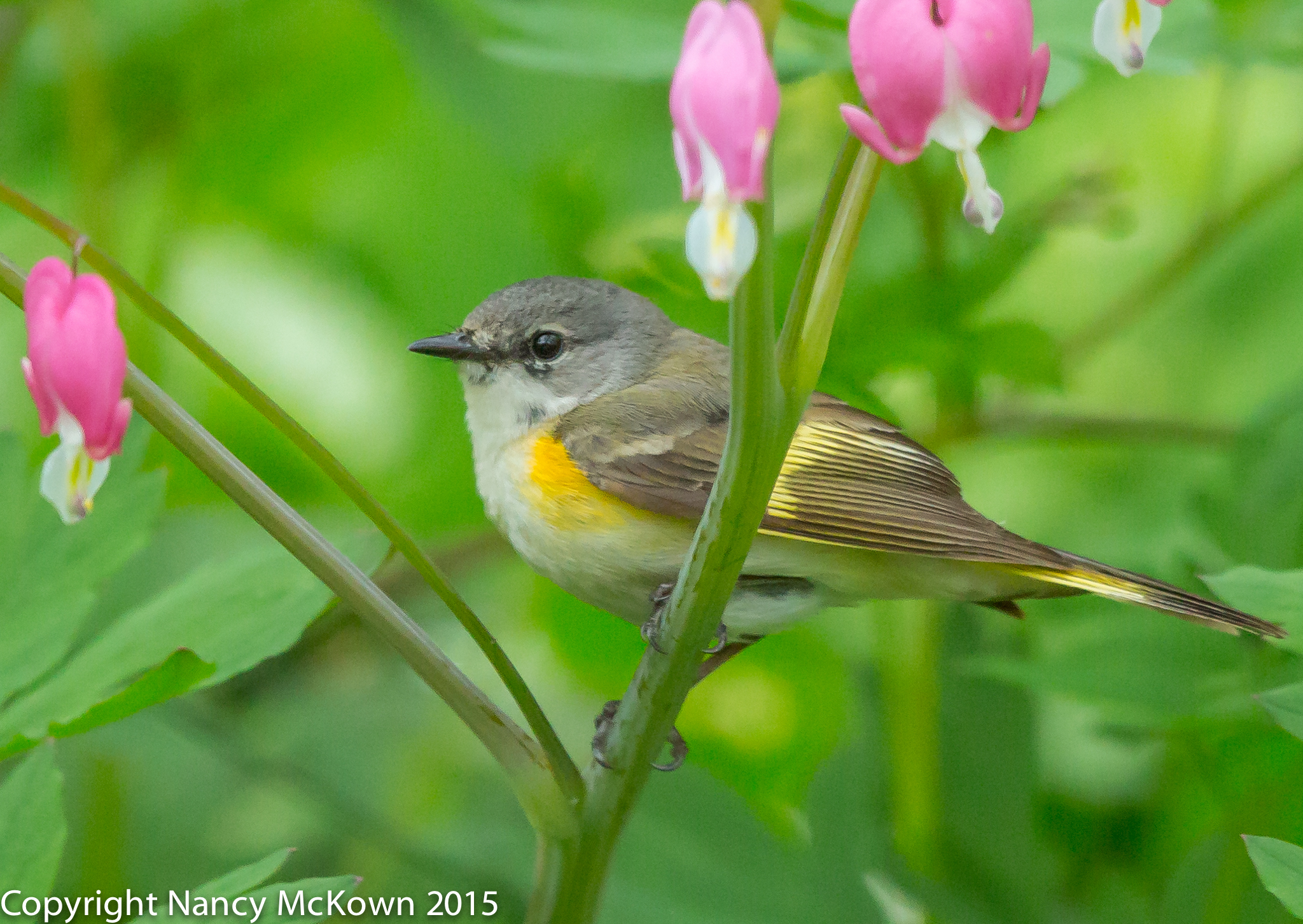
A female American Redstart Warbler nesting nearby often leaves the woodlands to forage in the trees around our library. Usually, she flits and flutters, constantly on the move, staying hidden behind the leaves as she hunts for insects. Once in a while she will momentarily light on a delicate bleeding heart plant, making for a beautiful photo if I am lucky enough to be behind the lens at that time. I enjoy watching her. Female Redstart Warblers are mostly a pale gray, with olive green wings and flashes of yellow and orange on her shoulders and tail feathers. The colors are especially beautiful when she fans her tail.

This particular Redstart appears to be very curious about the cameras, long lenses and me. Once in a while, she stops her foraging activity, perches close by, and just watches me.

Photo of Female American Redstart Warbler
Female American Redstart Warbler
Resting on a perch close to the Lens.
ISO2500; f/4; 1/500 second.

An Unexpected Visit

My library windows are usually wide open, with two cameras on tripods (one with my 500mm lens and one with my 300mm lens) pointing out to different parts of our garden. Insects of all kinds fly in and out, mostly destined to die on some window sill in another room. I keep a rotating fan blowing toward the windows — hopefully to discourage insects from coming in.

Memorial Day was not a fair weather day, so only one window was open. As I often do, I had left the cameras for a few moments to attend to something in another room. During that short interval, a female American Redstart Warbler flew into the library, through the living room and then made a beeline to another set of windows in the master bedroom.

Of course I can’t be sure that the female Redstart who entered the house through the window near my camera setup is the very same curious Redstart that I see so often in front of my camera. But I’d bet on it.  In the bedroom, she was fluttering back and forth against the window panes. Once in a while, she would rest on the window sill, watch me, and then try again, searching for a way out to the trees she could see, but not get to.

I opened the bedroom window almost immediately – but it took her a little while to find her way out. I grabbed my camera and took a couple shots of her before she left. She graced me with a fan of her tail then flew out and up to a nearby tree. Once she was comfortable, she turned her head back to look at me, then flew off to the woodland. I saw her again later the same day, foraging in her usual places….obviously not too traumatized.
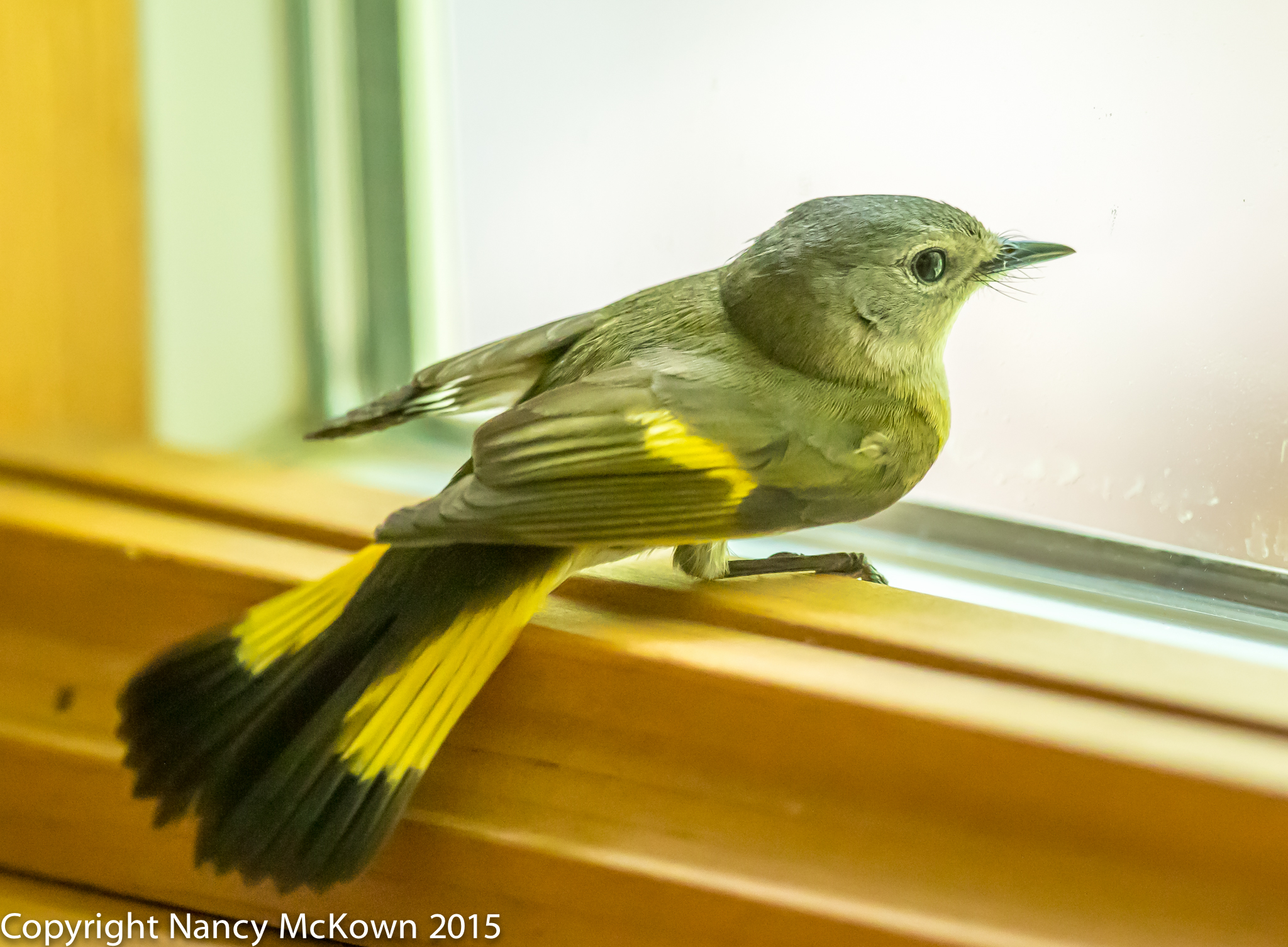
Photo of Female American Warbler
A Curious Female American Redstart
Warbler who Flew into Our House.
ISO 2000; f/3.5; 1/400 second.

Birds and Windows

Window glass is invisible to birds and potentially lethal when they fly in and strike the glass. Birds only see the reflected greenery and skyline and attempt to fly toward it.

Sadly, we hear the sickening thumps of a bird crashing into our windows almost every week. They leave  a splat of dust and feces behind. Most crash victims rest a few minutes after they bounce off the window and then appear to recover. They are able to fly away, although who knows how many of those birds die later of their injuries.

It is estimated that hundreds of millions of birds are killed world wide by flying into glass windows. There are many solutions designed to decrease or block the window reflections if you wish to safeguard birds from crashing into your windows. Visit this link if you would like more information.

Photo of Swainson's Thrush

Photographing a Migrating Swainson’s Thrush

Photographing the Swainson’s Thrush on His Spring Migration

photo of Swainson's Thrush
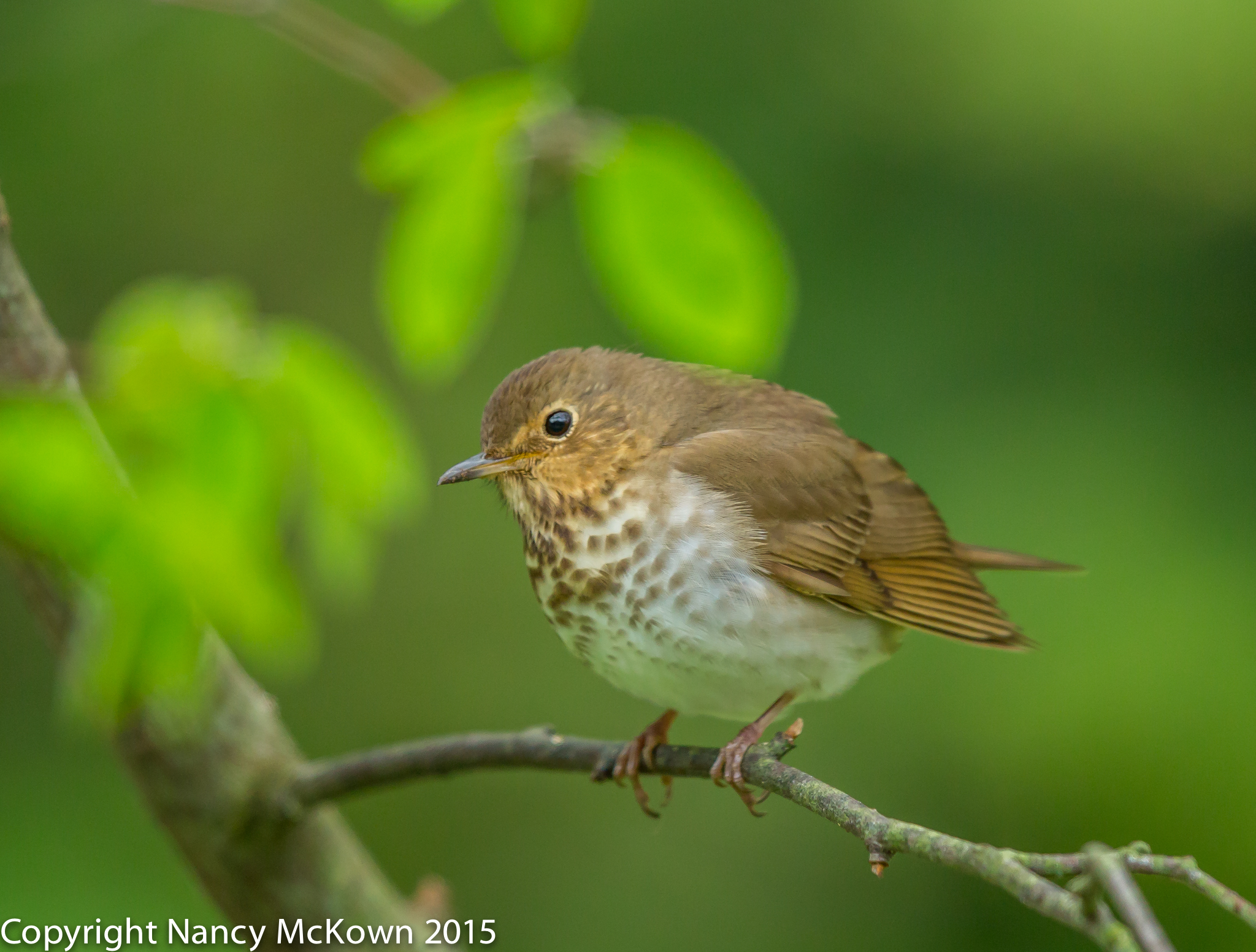
Swainson’s Thrush
ISO1600; f/4.5; 1/400 Second

Migration Photography

So many birds on their way to someplace else. Last Fall, I saw and photographed 28+ avian migrators as they stopped to rest and replenish (and pose for the camera) in our yard. My library windows have been open for a few weeks now, with 2 cameras at the ready, but visitor activity is minimal. It’s already the 4th week in May, late in the migration season, and I’m wondering if I should abandon my library viewing area and head out to the Allegan State Game Area in search of nesting activity. Fellow birders report seeing a variety of rarities, like the Yellow Headed Blackbird, the White Eyed Vireo, the Short Billed Dowitcher, Mississippi Kite, and the Yellow Breasted Chat, all dressed in their Spring splendor. No such luck for me.

Best not to get spoiled when pursuing the art of bird photography. After all, the trees have not been barren of transients. So far, I have been able to see and photograph (all or parts of) 17 familiar migrators passing through. Most of these actively hid from the camera and peeked at me (or my bird blind) warily.

Close Camera Encounter with a Swainson’s Thrush

One exception was this little Swainson’s Thrush, who posed in full view and close to my 500mm lens. Swainson’s Thrushes often pass through our lakeshore migratory route on their way to nest in the UP, Canada, Alaska, Northwest United States and the upper New England states. Not a new bird for me, but he was very welcome nonetheless.

Like most birds, this migrator often hides in the shadows. I heard his captivating flutelike song before he graced me by flying in right in front of the camera. He stayed only a few minutes, long enough for 25+ shots, and then he was gone.

Photo of Swainson's Thrush
Swainson’s Thrush
ISO1250; f/4.5; 1/400 Second

Capturing the Moment

During this time of year, it’s hard to overestimate the part dumb luck plays when encountering and photographing transient birds. This is true even though there are literally billions of birds migrating through. Of course, regardless of luck, a photographer still has to be ready if she hopes to beautifully capture the moment. Being ready takes hard work, persistence, experience, quiet anticipation, good equipment, patience and most especially, quality of light.

Migration – A Wondrous Phenomenon

There is surely no bird photography experience more thrilling than nailing it…having the camera set up and pointed in the right place at the right time to capture and preserve the memory of a migrating bird before they are gone into the vastness. Migration surely is a wondrous phenomenon.

To see photos of the migrating birds that I was able to photograph in our yard this Spring and last Fall, please visit this Flickr link.

Photo of Vesper Sparrow

Photographing Vesper Sparrows And Using The Tripod Collar

Photographing Vesper Sparrows

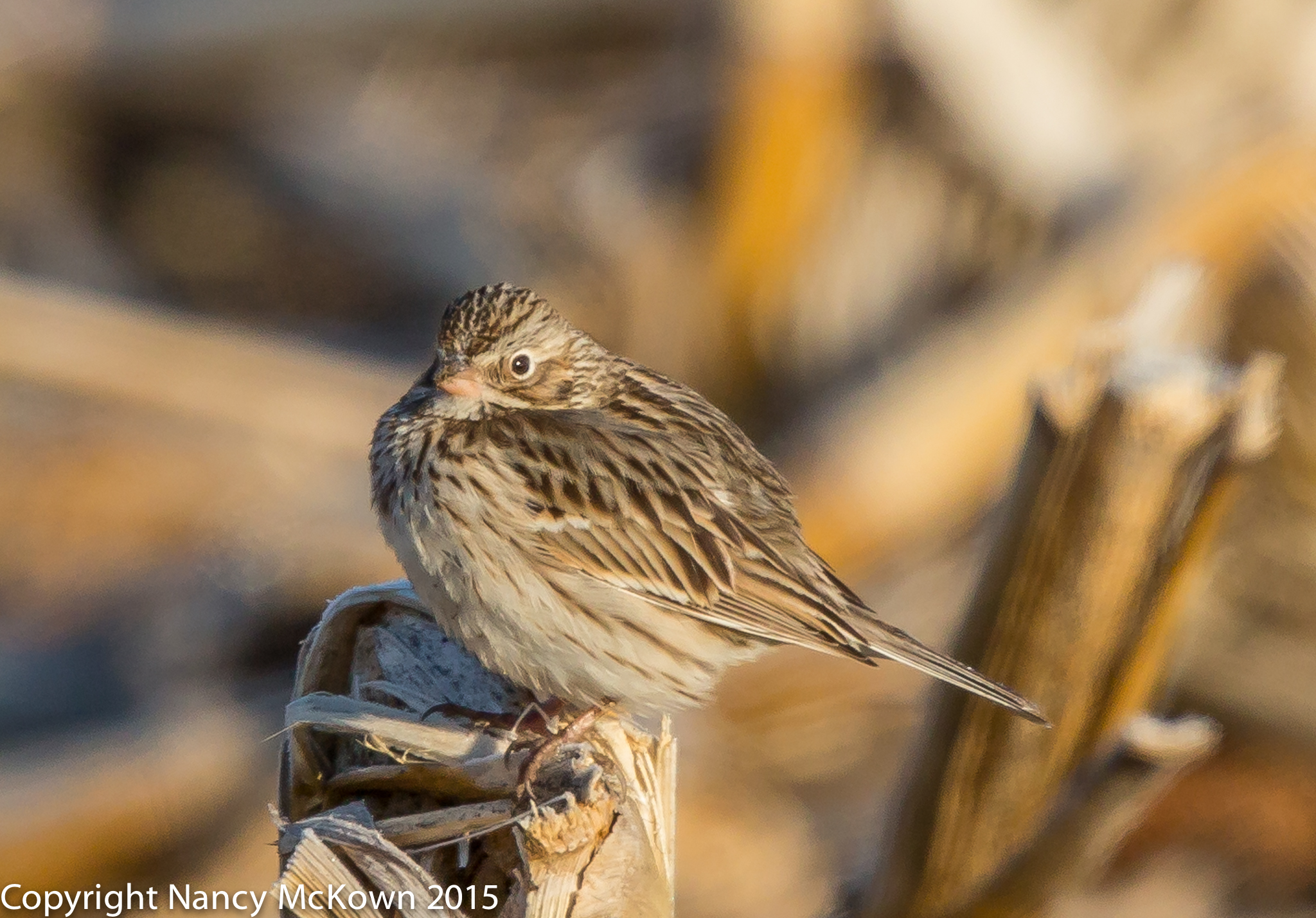
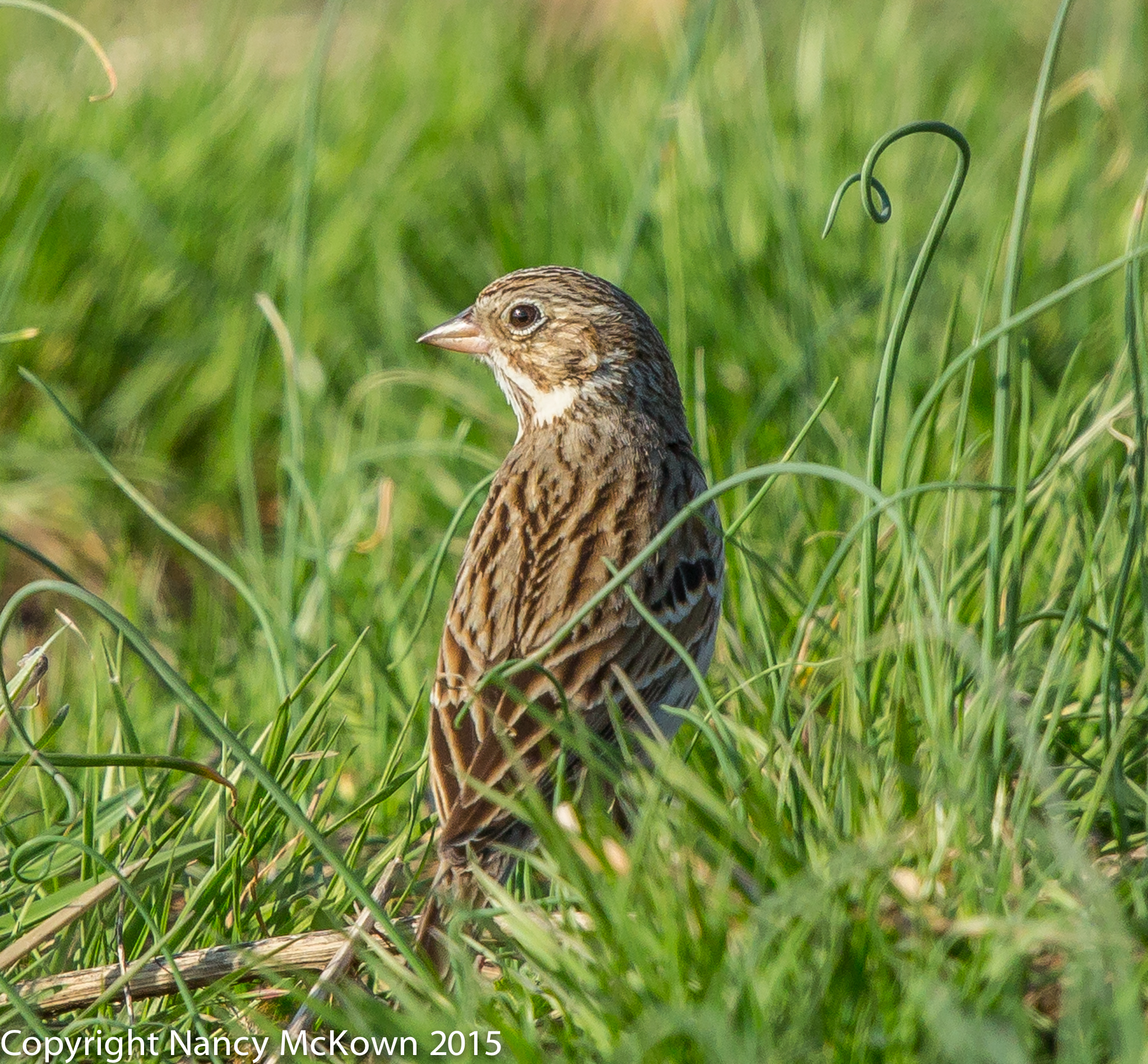
I came across what I thought was a song sparrow, foraging in the grass and cornfields in the Allegan State Game Area. It was early, and the sun was pleasingly low in the sky and at my back. Resting the camera on the car door window, I shot these photos using the 500 mm lens and 1.4 telephoto extender. Through this amplification, I could see that this was a new sparrow for me, chunky, with a very distinctive eye ring. Like most sparrows I’ve come across, the Vesper sparrow has a lovely song. Unlike most sparrow species, they hide their nests on the ground under clumps of grass.

Photo of Vesper Sparrow
Vesper Sparrow Foraging in the Grass.
ISO800; f/8; 1/2000 Second

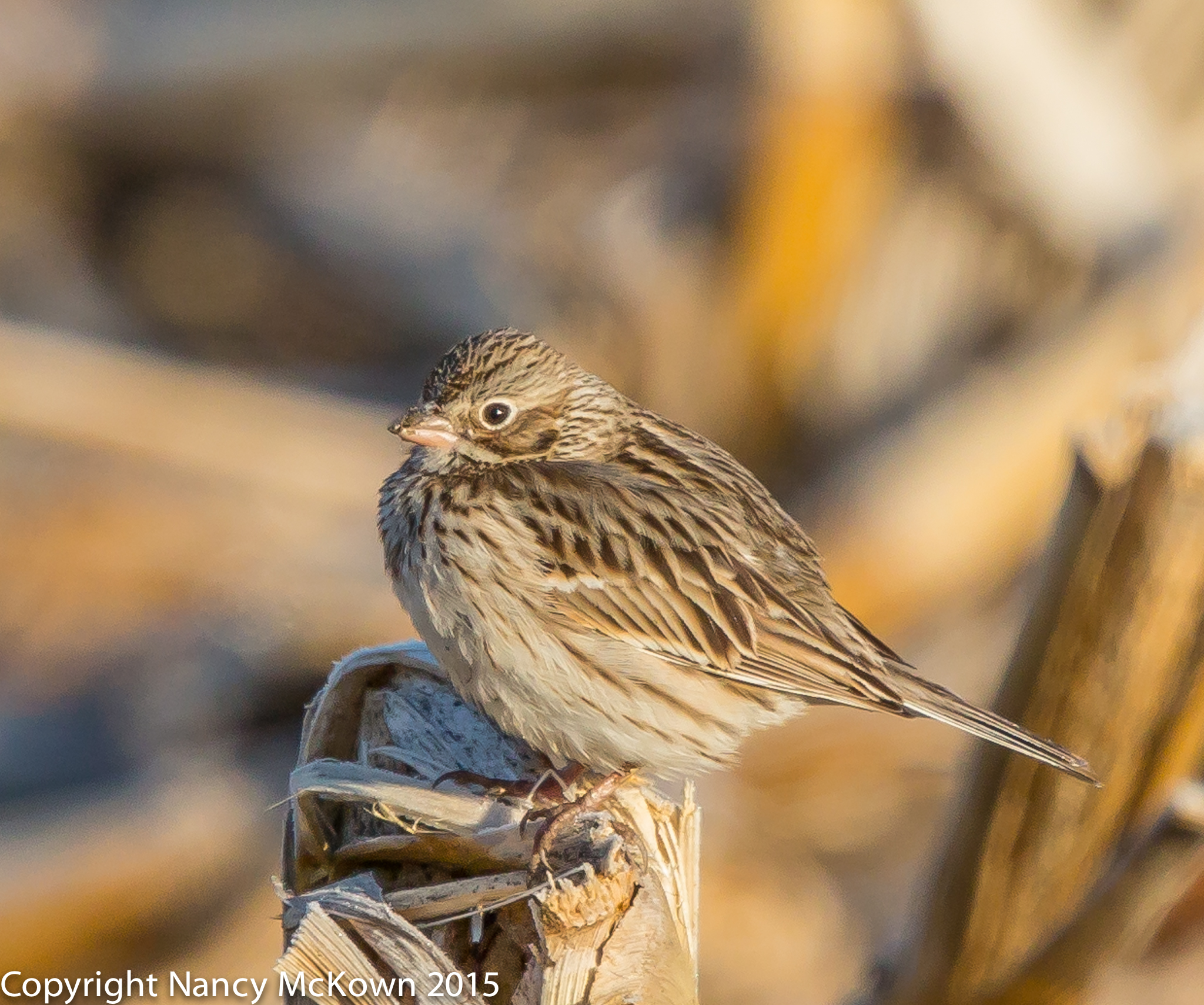
In the second photo, the car’s shadow was included in the frame. To help eliminate that shadow, I rotated the lens from portrait to landscape using the tripod collar. I like how the out of focus corn stalks behind the Vesper Sparrow’s perch add color that matches his feathers. Overall, the colorful bokeh helps make a more pleasing frame.

What Is That Knob For?

Ever have something right in front of you and not associate it with a useful mechanical function?  A simple question “What’s that knob on my lens for?” is all I would have needed to ask. Instead, for quite a long time, I was blind to a function on my lens that is basic, simple and easy to use.

Photo of Vesper Sparrow
Vesper Sparrow perched on a corn stalk
ISO800; f/8; 1/2000 Second.

 The Simple and Elegant Tripod Collar

I assumed that the L shaped lens foot place precisely at the center of gravity on my long lenses was designed only as a carrying and mounting “handle”.  I thought its purpose was to safely carry and manipulate a camera/long lens and secure it firmly to a tripod head.

It makes so much more sense now. The lens foot is attached to a rotational collar that allows the user to turn the lens without disrupting the focus or zoom functions. It’s simply a matter of loosening the collar (hence the obvious knob) and rotating the orientation of the lens from portrait to landscape, or any position in-between. For the longest time, when I was not using a tripod, I swiveled the camera body to achieve this function – a much more cumbersome process. At other times when using a tripod, I repositioned the joystick head on the tripod so the whole setup hung off to the side…a precarious and wobbly mess. Dumb!

There are dozens of sophisticated functions on modern, professional DSLR cameras that photographers struggle to master. The tripod collar is like flipping a switch….. basic, easy and essential.

Photo of Wilson's Snipe

Photographing a Wilson’s Snipe and the Great American Bird Count

The Great American Bird Count – May 9, 2015

The Great American Bird Count (a twice-annual bird count) is scheduled for Saturday, May 9, 2015. This day long spring event is organized to create a one-day snapshot of the abundance and distribution of birds during spring migration.

Expertise is not needed, only a willingness to watch, record and then report the individual number of each species of birds you see. All species are included. I’m going to be tallying the birds at and near our feeders on the south side our our house. Most counties have organized volunteers to coordinate efforts, (so there won’t be overlap in the counts) tally, and then report the findings to E-Bird at the Cornell Lab of Ornithology.

Photo of Wilson's Snipe
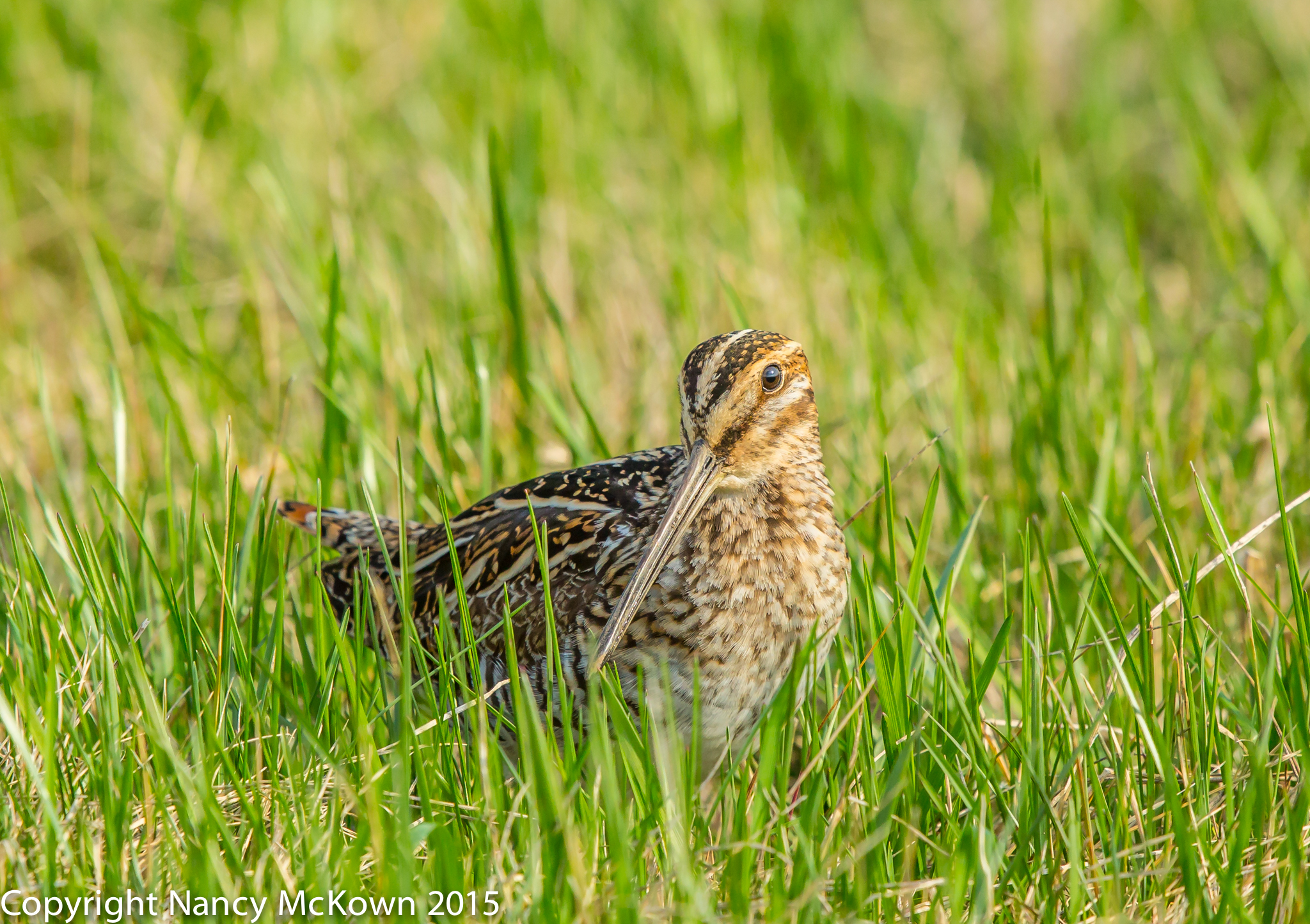
Wilson’s Snipe.
Walking in the Grass with His Tail Feathers Pointing Up in a Jaunty Pose.
ISO640; f/8; 1/1600 Second

Photographing the Wilson’s Snipe

I first saw this Wilson’s Snipe precariously balancing on a high, barbed wire fence at the local airport. Sitting in my car with the camera, 500 mm and 1.4 extender resting on the driver’s car door window, I watched, waited and hoped he would move off of his unappealing perch. He looked like he was struggling to remain there, but he persisted, adamant in his Spring induced efforts to be noticed.

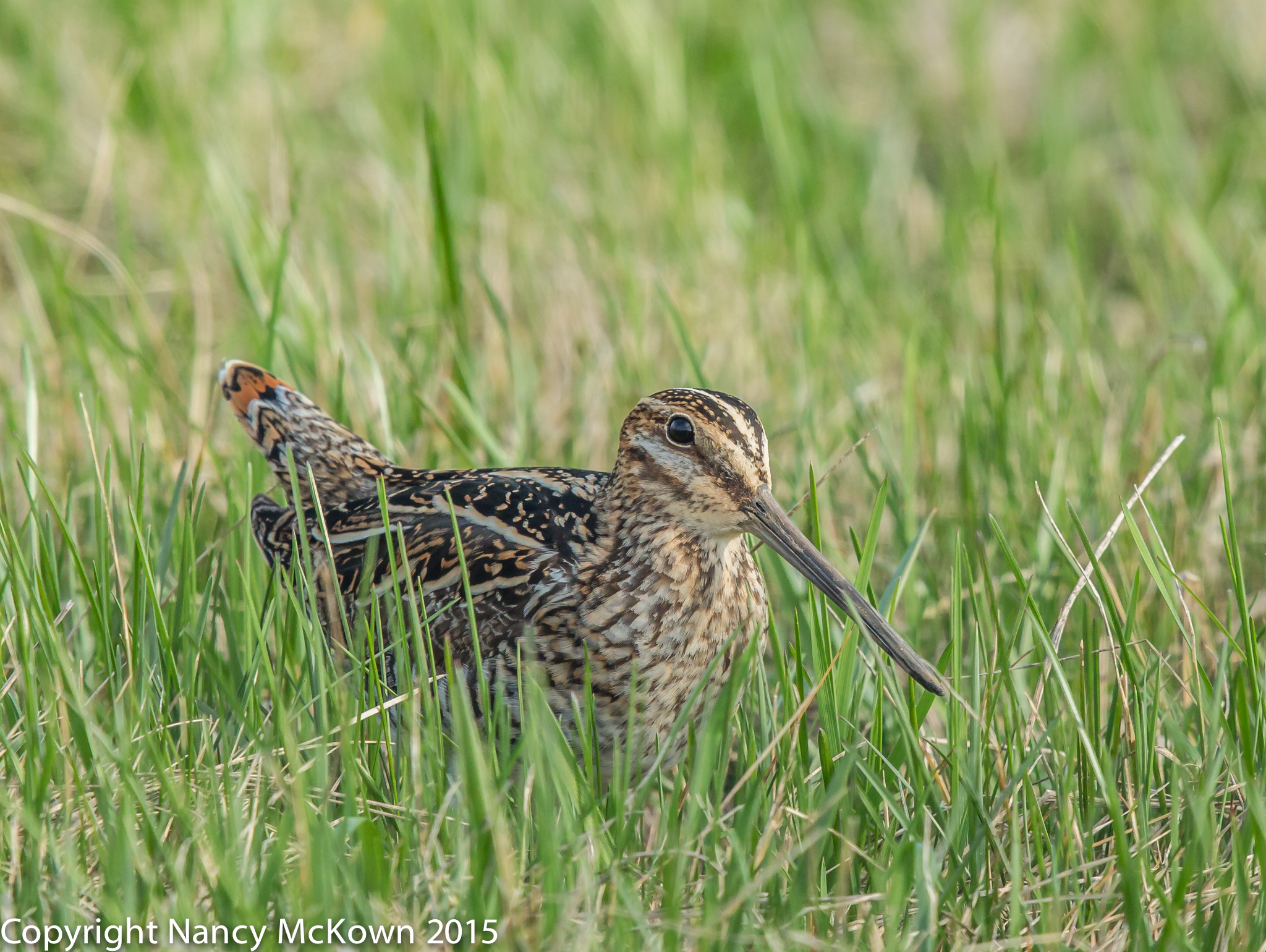
Finally, he took a break from singing and floated down to the grass to rest right in front of my camera. His short neck and legs matched his stocky body, but contrasted markedly with his very long beak. His eyes are set way back … almost at the top of his head, giving the curvature of his head a very odd appearance. The Ebird map indicates that this little sandpiper is an uncommon nester in SW MI.

Photo of Wilson's Snipe
Wilson’s Snipe, resting in the grass.
ISO 1000; f/8; 1/1250 Second

I love Spring migration. So many birds, new and lovely, some I have never seen before. Watching and photographing them in all their dazzling plumage is very gratifying.

Cornel Lab Global Network of Birders

The E-Bird Bird Count scheduled for May 9th is a global scientific and conservation effort. Birders from all over the world will be watching and recording their location and counts. Here’s the link if you wish to be a part of this worthwhile effort.